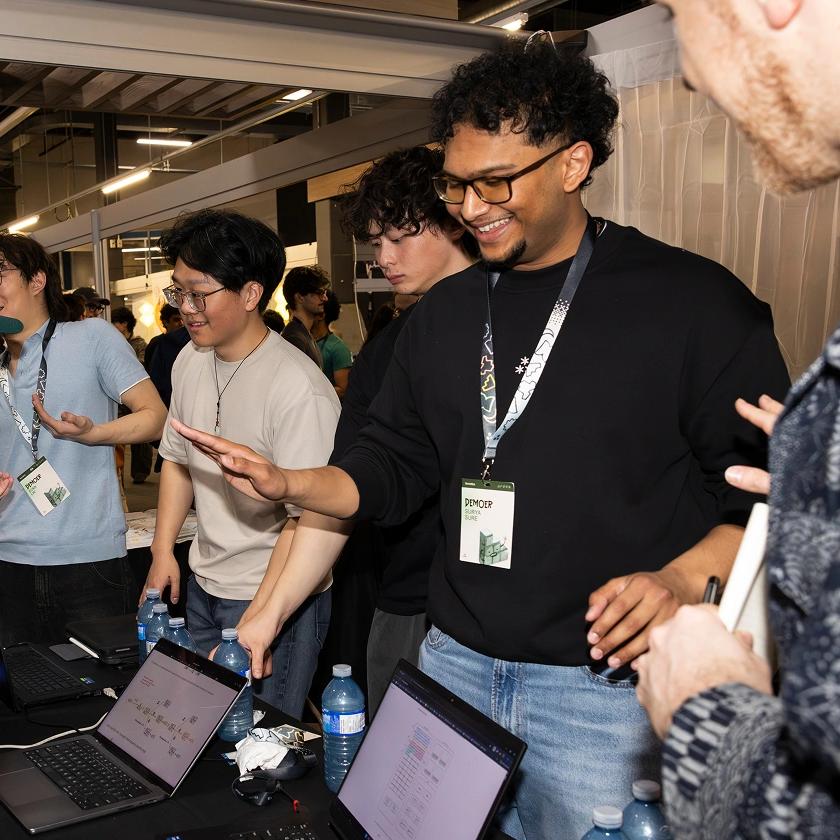
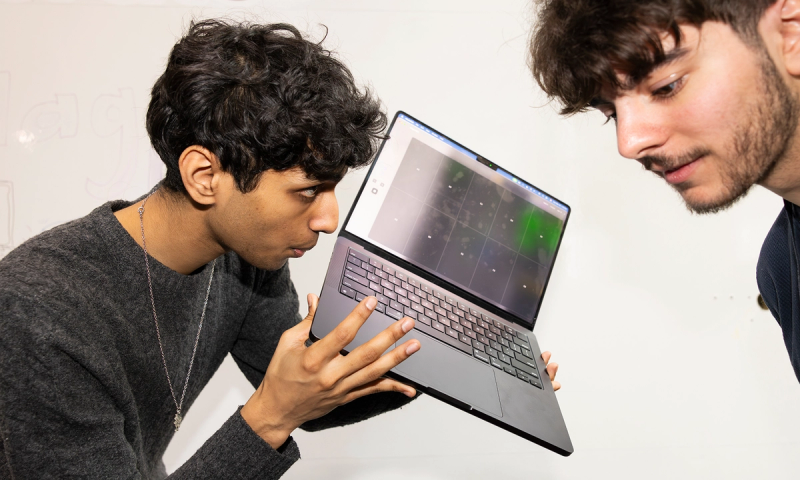
Krish Shah hands me his MacBook and tells me to blow on it. “Aim for the tab key,” he says. When I lift the laptop to my lips and exhale, its speakers emit a brassy honk. I glide my fingertips along the trackpad and the pitch rises and falls. Shah, a lively software engineering student at the University of Waterloo, smiles as he watches. How could he not? He’s MacGyvered his computer into a trombone, a feat as impressive as it is absurd. And now, on a Sunday afternoon in late March, hundreds of people want to give his invention a try.
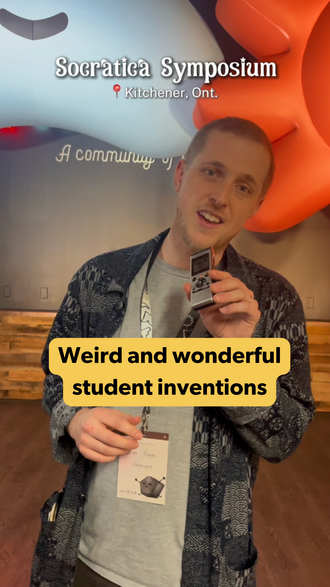
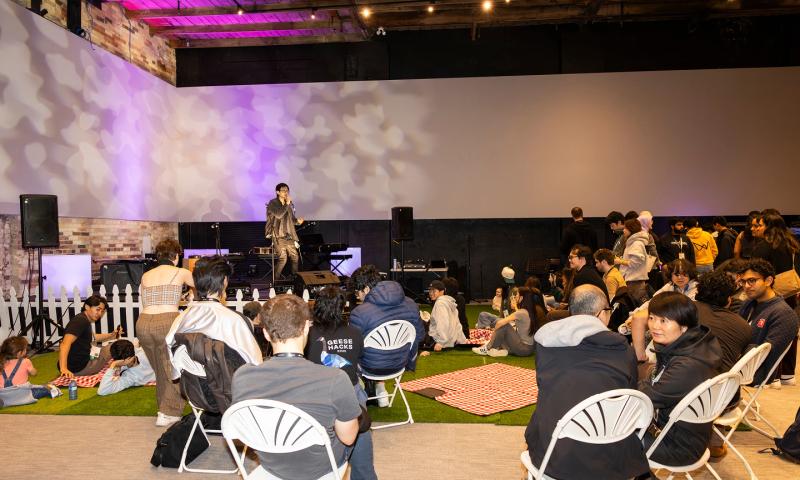
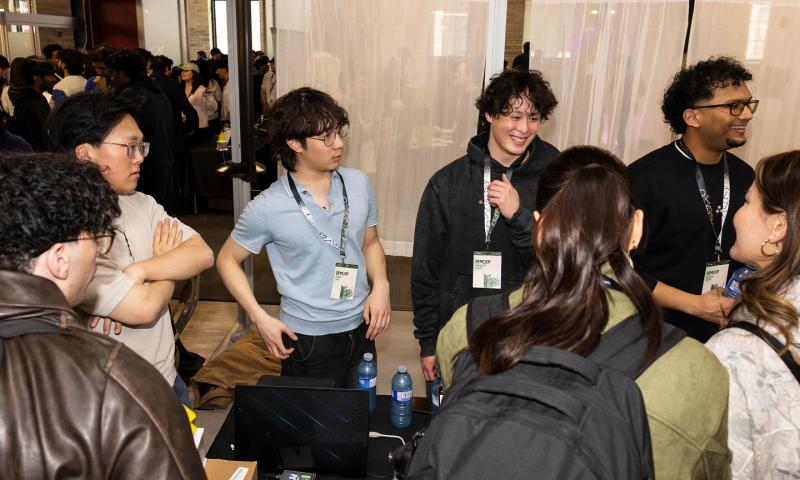
Shah’s musical machine, MagicMidi, is one of 70 projects on display at the 2026 Socratica Symposium, a weekend-long event in Kitchener, Ont., dedicated to showcasing students’ weird and wonderful creations. It’s equal parts tech expo, art gallery, arcade, nightclub and world’s fair, if said fair were organized by a bunch of hyper-online Gen Z geniuses who happen to be best friends. Over the course of the afternoon, 2,000 twentysomethings come through the refurbished Tannery Building, squeezing past one another to play their roommates’ video games, check out their classmates’ robots and see if they can convince someone from Shopify to give them a job.
Speaking of robots, there’s one on the table opposite Shah – an emotive contraption called LeLamp that swerves, ducks and speaks. In the next pod over, a mob has formed around Khaos Keys, a game that answers the question: what if Guitar Hero were played on a computer keyboard?
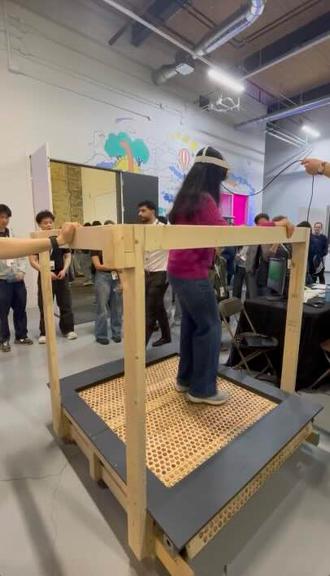
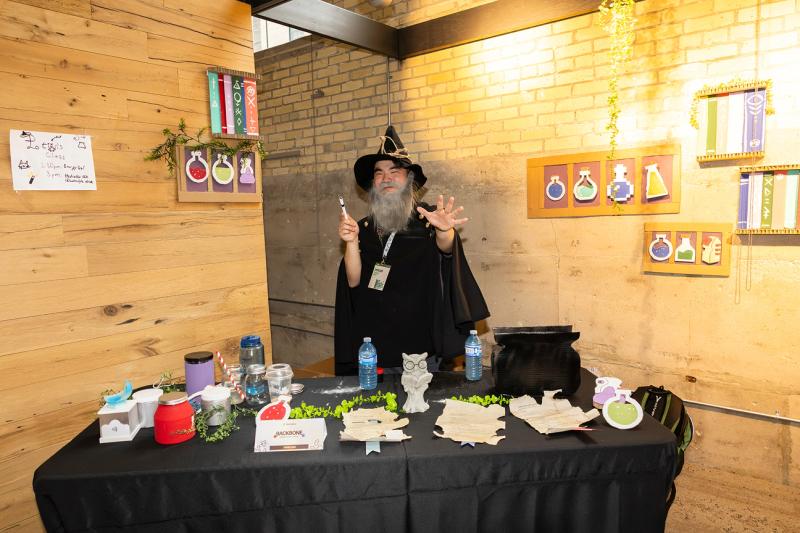
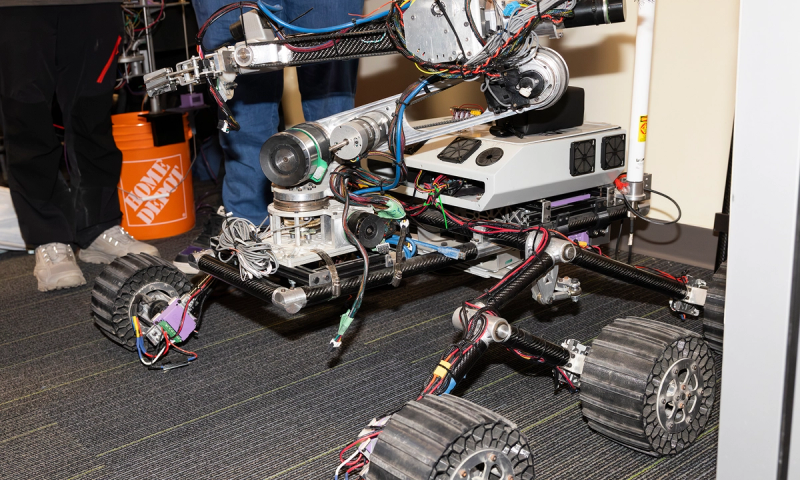
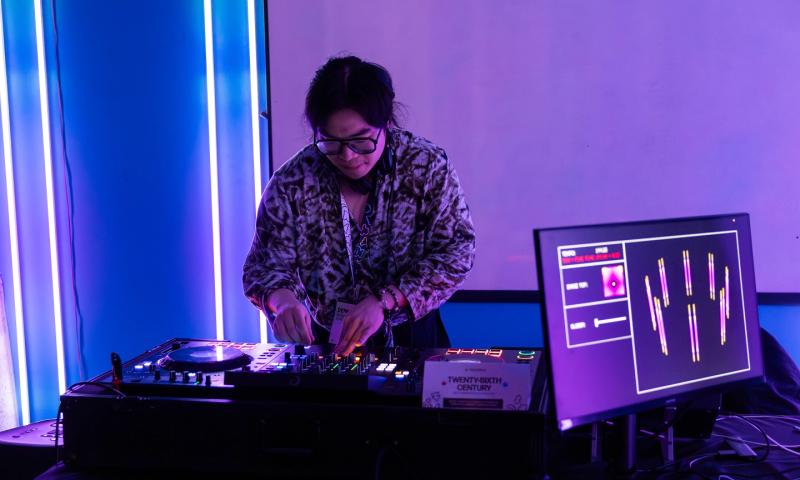
Elsewhere in the exhibition hall, a guy dressed as a wizard is showing off his homemade energy supplements, a young woman is tending to a flock of handmade stuffed animals, the members of a robotics club are detailing how they built a $16,000 space rover, illustrators are churning out caricatures at live portrait-drawing booths, and a cyberpunk arts collective called Twenty-Sixth Century is throwing an AI-assisted drum-and-bass rave in what appears to be a cleared-out conference room. In the middle of the action, revellers are queuing up to try the expo’s hottest attraction: Evrst, an omnidirectional treadmill that allows users to walk around VR worlds while staying in one place IRL.
Disparate as they may seem, every one of these projects shares a common thread: they’re the products of a cultishly popular club called Socratica, or one of the many offshoot organizations it has inspired at campuses across Canada. Founded four years ago by two University of Waterloo engineering students, Socratica is, at its core, a community of smart, self-starting youngsters who meet weekly to work on passion projects together.
“Waterloo was always – and still is – this machine that produces high-quality tech talent,” says Socratica co-founder Aman Mathur. That’s a good thing, of course, but it can manifest in odd ways. “You kind of go through the motions of getting internships and everyone’s mind is always on getting that next job: ‘How do I work at Google?’ But no one was thinking, ‘How do I create the next Google?’”
Mathur and his co-founder, Adi Sharma, wanted to restore something that had been lost in the all-consuming quest for good grades and better co-op placements: the space and support to make stuff that actually interested them, whether that be starting a company, building a drone, drawing a comic book or turning a laptop into a trombone. “We’re not doing it so you can get funding,” says Mathur. “We’re not doing it so you can get a job.” They’re doing it, Socratica members like to say, “for the love of making.”
As it turns out, something funny happens when you give bright young minds permission to gather, explore and experiment without any expectations of getting a job or funding: they end up creating things that get them jobs and funding.
At the symposium, one of the busiest booths belongs to a team called TinyTPU, four young men from Western and U of T who became tech-world micro-celebrities when they figured out how to backwards-engineer Google’s proprietary AI chip, an achievement that earned them a meeting at Google and jobs at Nvidia.
Another notably bustling booth: the one belonging to Kleiner Perkins, the influential Silicon Valley venture capital (VC) firm that specializes in incubating early-stage companies. VCs from firms like Antler and Panache are making the rounds, too. The chatbot Claude and design platform Figma both have tables; they’re sponsors. So is Shopify, whose head of early talent is in attendance and scouting for interns. It’s easy to spot the investors and headhunters. They’re the only ones over 30.
Of all the creations these outsiders are scoping out, the most monumental is Socratica itself. In four short years, the non-profit has kickstarted the careers of hundreds of entrepreneurs, launched dozens of startups and formed a highly employable network of friendly, fun-loving brainiacs that extends well beyond Waterloo. There are now Socratica nodes in more than 40 cities on every continent but Antarctica. Each of those outposts throws its own events, but the annual symposium in the Waterloo region remains the organization’s crown jewel.
“The dream has always been to make the symposium like a Taylor Swift concert,” says Waterloo math student Hudhayfa Nazoordeen, who helped organize last year’s event. “Imagine we fill the entire Rogers Centre with people, it becomes this pilgrimage, and Canada becomes a mecca for makers, tinkerers and people who create great things to come to. Within a few years, we’ll get there.”
If Socratica is on its way to becoming a mecca, it’s already a launchpad, blasting smart Canadian kids to countries and companies all over the world. Sharma, the group’s co-founder, goes to the node in San Francisco, where he and scores of other Socratica people now live. “It’s a known thing that the city is basically run by Waterloo, and Canadians in general,” he says. “And lately, the Socratica talent pipeline has been insane.”
Socratica started, like so many creative pursuits did, during the pandemic. Its founders had both come to Waterloo – Mathur from Markham, Ont., Sharma from Grande Prairie, Alta. – because it had a reputation as a great place to build a company. But, says Mathur, “halfway through my schooling, COVID started and everything shut down. That bustling energy was completely gone.”
By early 2022, campus had opened back up, and the two friends were eager to meet face to face with like-minded makers, tinkerers and entrepreneurs. They dreamed of a space where creators of all stripes could come together, work without fear of failure or judgment, make friends and get swept up in each other’s ideas. Sharma tweeted a casual invitation to a three-hour, Pomodoro-style co-working session inside the university’s engineering building. About a dozen students showed up, so the group gathered again the following week, and then the week after that.
“From day one, one of our rules was no school work and no work work,” says Mathur. “As soon as you say that, people usually already have something they want to work on – this project they put off from three months ago or this idea they’ve had since they were a kid but never got a chance to work on.”
He and Sharma believed that those pursuits – the projects that felt too odd, ambitious or out-there to pursue in polite company – held the most potential. So Sharma went searching for students with the audacity to actually give them a go. “I became like a detective,” says Sharma, “like, ‘Who is doing weird things and following their own curiosity to an extent that is beyond what is socially acceptable?’”
That detective work quickly led him to Anson Yu, a younger engineering student who was similarly underwhelmed by Waterloo’s post-pandemic malaise. “University was the promised land, like, ‘Here are all the nerds. You all get to hang out and make cool things,’” says Yu, who came to Waterloo from Langley, B.C. “But when I got here, I was like, ‘So, where is it?’” Instead of creating amazing stuff, her classmates seemed more interested in “comparing salaries and grinding LeetCode” – that is, practising their programming skills. “You have all these brilliant people who are under-exploring their creativity.”
To inspire students to dream big, Yu co-founded a group called UW Startups with her friend Jocelyne Murphy. As Murphy saw it, the problem was never her peers’ skills; it was that, coming out of COVID, students were lonely, disconnected and discouraged. “Nobody feels qualified to consider themselves an entrepreneur. It’s way too intimidating,” says Murphy. “Especially as a young person, when you want to do something, you’re often met with, ‘Here are all the reasons you can’t do it.’”
So she and Yu started hosting dinner discussions under the UW Startups banner, encouraging people to be bold and believe in themselves. The meetings were open to students from every department, not just engineers. “The messaging was, ‘Have you ever once thought that perhaps the world could be different than it is? Then you’re qualified to be here.’”
UW Startups and Socratica attracted many of the same people, so the two organizations eventually merged into one. They met on Sunday mornings, starting every session with a pledge: “I will not be a menace. I will clean up my own garbage, and the occasional additional cup. But most important, if I see someone standing alone in a corner, I will go be their friend.”
When Mathur and Sharma graduated, they left the organization in the hands of some of its founding members who, in turn passed it to others, and so on. The group selects a new batch of student leaders every four-month term.
“We didn’t have an application system,” Yu explains. “We just paid attention to whoever stuck around after meetings to clean up.” By now, Socratica has had dozens of leaders, or hosts, as they call them. Some have planned scavenger hunts and thrown dance parties; others have organized creator retreats and hosted film festivals. “Every single person who has touched the organization has left [their] mark on it,” says Yu.
No matter who’s in charge, cool stuff floweth. Socratica members have created a brain-computer interface, filmed a feature-length documentary about climate solutions, developed a hydroponic farm and built a replica of the Grumobile, the vehicle driven by the villain in Despicable Me.
One of Socratica’s most viral creations was the nuclear reactor that math student Nazoordeen made in his bedroom. He didn’t know much about nuclear physics or electronics, but at Socratica, he says, “there’s this feeling that anything is possible…. You don’t really think about what’s going to stop you. You more think about, ‘What can I actually do?’”
The answer, in Nazoordeen’s case: build a mug-sized nuclear fusion prototype from scratch with help from his bewildered roommates, guidance from the chatbot Claude and $2,000 worth of parts he bought off the internet. The reactor didn’t achieve full-blown fusion, but it did produce a glowing orb of plasma, a sort of stepping-stone to fusion. “It just kind of engulfed my entire life,” he says. “It got a lot of attention because it’s extremely dangerous. It could kill you.”
Last year, Nazoordeen became a Socratica leader and tried another thing he had no idea how to do: host a 2,500-person symposium inside a rented-out hockey arena. In typical Socratica fashion, the one-day bacchanal featured a bass-playing robot, a poetry reading, a self-driving go-kart, and a student recounting her successful campaign to get googly eyes put on Boston’s subway trains.
The 2025 symposium was a milestone in Socratica’s transformation from Canadian success story to global phenomenon. Though Socratica nodes had already popped up across the country – Meraki in Toronto, Momentum in London, Atelier in Vancouver – the event helped put the organization on the world map. On the Slack channel that serves as a central hub for all the Socratica nodes, newcomers logged on from Brazil, Indonesia, Nigeria and beyond. “We were just dumbfounded,” says Yu. “From Tokyo? From Berlin? Like, what do you mean?”
For Yu, the group’s growth is a testament to the universal appeal of Socratica’s foundational idea: providing creators the time and space to create. “If you do the thing that you like to do, things will turn out better than if you were trying to fit yourself into a mould or a track that’s prescribed to you,” she says. “You also have more fun, so you work harder, and then you attract friends that care about similar things, so then that makes you have more fun and work harder. It’s this spiral of positive reinforcement that people can’t help but want to participate in.” Investors and headhunters included.
From the beginning, Socratica’s founders were clear: the club wasn’t meant to be about getting jobs or funding. But, also from the start, people with access to capital were paying close attention.
Contrary, a San Francisco-based venture capital firm that had employed Sharma and Yu, sponsored Socratica’s first sessions. Jesse Rodgers, the founding director of U of T’s Creative Destruction Lab and a staunch supporter of Waterloo, helped fund the organization, too. And it didn’t take long for the group to show up on the radar of John Dick, who heads Velocity, the University of Waterloo’s entrepreneur incubator.
“I was immediately excited by what they had been able to put together,” he says. Waterloo already had plenty of hackathons and tech clubs, but Socratica felt different to Dick. There were as many women as men, as many artists as engineers. And they all seemed obsessed with making stuff. “A big chunk of my job is finding entrepreneurially minded students and training them,” says Dick. “And here was a group that had already found a bunch of them.”
Velocity is an example of what Socratica folk like to call “values-aligned sponsors.” Shopify, Figma and Claude fall within that category, too, because they’re all tools that creators can use to advance their own endeavours. There’s something in it for those companies, too, of course.
Back at the symposium, I speak with Alison Evans Adnani, who leads Shopify’s early talent programs. Her team hires hundreds of interns every year, so it’s a no-brainer for the company to support Socratica, a sort of bottomless font of technical talent. Shopify helped start the node at the University of Toronto, funds Socratica events and occasionally buys mass quantities of pizza to feed the people who attend them. In Evans Adnani’s eyes, it’s a win-win: Shopify gets access to a pipeline of young whizzes, and students are provided a path to working for one of Canada’s top tech employers.
In addition to the symposium’s sponsors, headhunters and investors are also poking their heads in, and a few booths seem explicitly interested in courting them. Outside one darkened office, a sleek, six-foot banner advertises a product called Auditorium AI. Inside, music is blaring, and the walls are awash in blues and reds and greens. The light show is AI-generated, and it syncs automatically to any song; it can even adjust to a live video feed of a venue. It’s a lighting technician in a box, basically. I spend about 30 seconds in the room before I overhear a student proudly disclosing that the company is funded.
On the whole, however, Socratica still seems indifferent to the gaze of investors. Scattered throughout the symposium are not only zany gadgets and cutesy art projects but also students who seem more interested in serving the public good than chasing profits. There’s a robot that helps seniors live independently, an initiative dedicated to getting clean drinking water to the communities that need it most, and a booth that aims to inspire youth to get involved in climate action.
These do-gooder projects point to another one of Socratica’s draws: it’s the rare place where not-yet-jaded students can still lean into hope rather than being beholden to the market. No one’s talking about stuffing their apps with ads or extracting and monetizing user data. It feels as if there’s a forcefield surrounding the symposium, keeping enshittification out.
This can sometimes result in an amusing mismatch for investors. Inside the Tannery, I end up speaking with a VC named Alex Wright. He works for Antler, a Singapore-based firm that advertises itself as “the world’s most active early-stage investor.” In other words, if there’s a guy a young founder might want to impress, it’s Wright; he has the power to cut a $250,000 cheque in exchange for nine per cent equity of a company, a potentially life-changing deal for any budding entrepreneur.
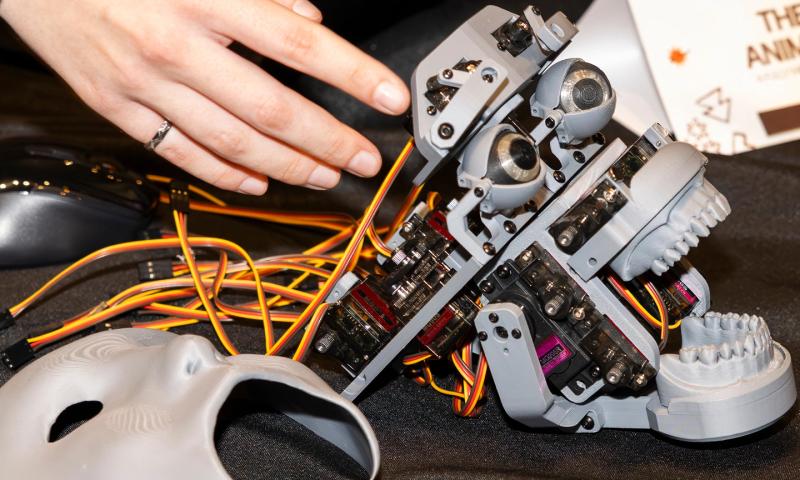
But, he tells me, not much is catching his eye. He describes the symposium as a “tech farmer’s market” – a nice place to spend an afternoon, but not necessarily a breeding ground for billion-dollar businesses. Case in point: as I chat with Wright, the nearest booths belong to a young man practising traditional tailoring techniques and a woman who tried to build an animatronic replica of the Adjutant, a humanoid robot from the video game StarCraft II.
“I’m glad I came,” says Wright, “but putting on my investor hat, I’m not hyper-interested.” Still, he doesn’t seem disappointed. The projects may not be the right fit, but Wright can’t help but marvel at the people making them. “Waterloo students are just different,” he says.
Back by the laptop trombone, I overhear Krish Shah talking to another over-30 (read: potential investor or recruiter). The man asks Shah if he has a background in music. No, Shah responds; he doesn’t even play any instruments. “I figured I’d be the one guy who plays the laptop,” he says. When asked what’s next for his invention, Shah dithers. Customers can purchase a MagicMidi subscription for $5 a month, but, Shah admits, it’s more of a passion project than a full-on company. And it’s far from his only iron in the fire. He’s interned at Meta and X, and he’s got plenty of other business ideas. “I’m building a laundry-folding robot,” he says. “Laundry is unsolved.”