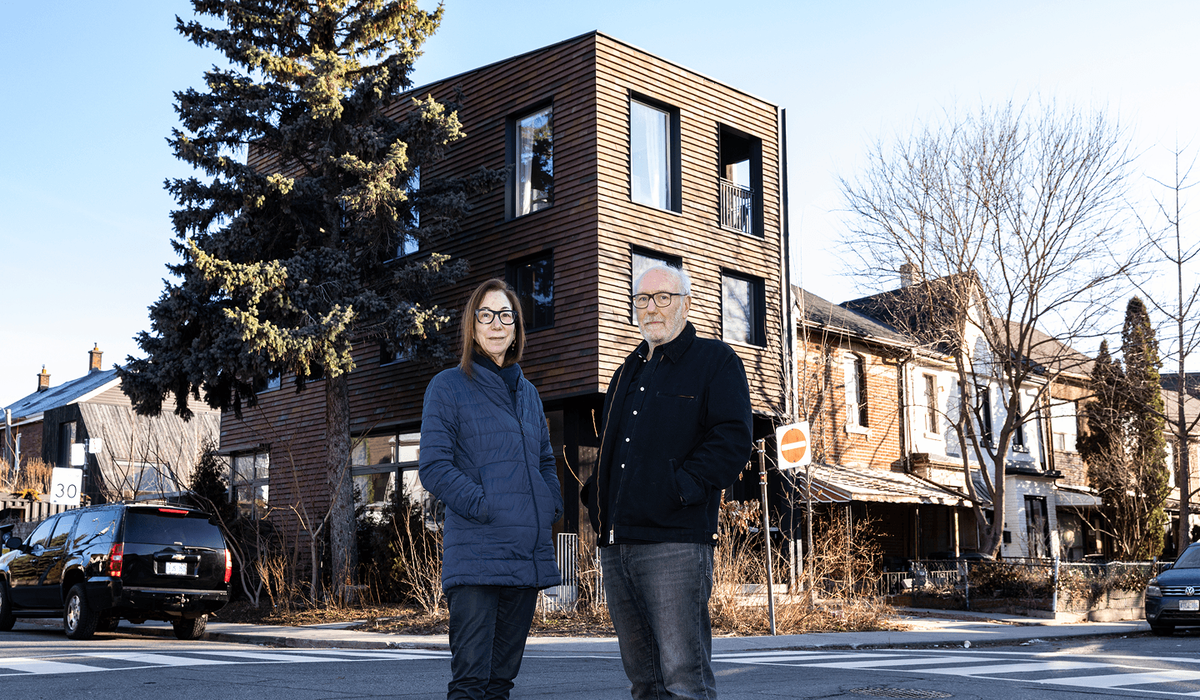
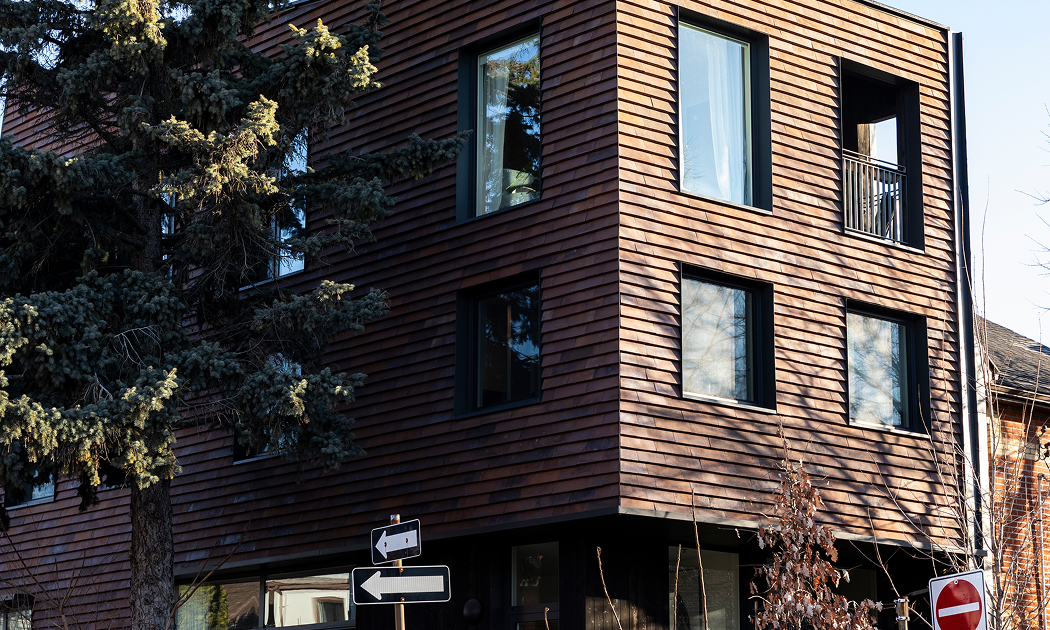
At first glance, Ulster House, a new build in Toronto’s Harbord Village, doesn’t look especially different from the other houses around it. Clad in earthy clay shingles, the three-storey structure sits beneath a leafy canopy of century-old trees, just like its neighbours do, and registers as a slightly taller family home.
Inside, however, the building tells a different story. It features five spacious apartments, including an elegant laneway house (or secondary dwelling) at the back of the property, an arrangement that creates residential space for multiple individuals and families on a lot that previously made room for one.
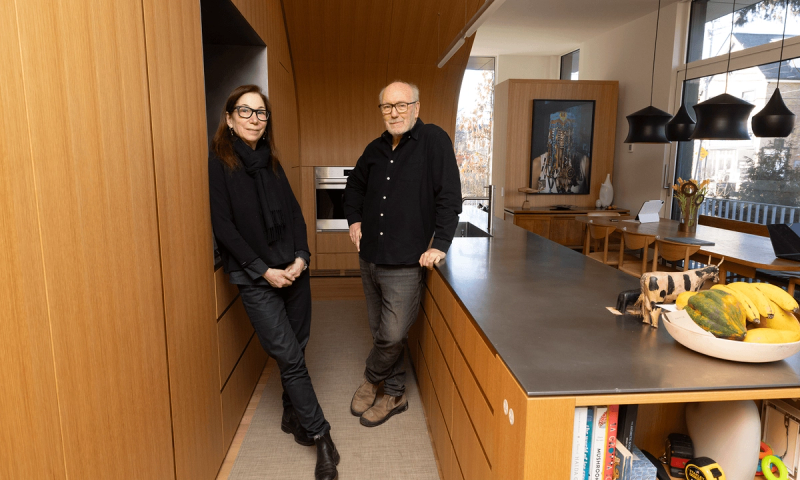
Toronto architect Janna Levitt says she and her partner, Dean Goodman, wanted to build the complex to demonstrate that it’s “not only possible, but desirable” to increase density in neighbourhoods dominated by single-residence homes.
They’re not alone. Levitt and Goodman are part of a new generation of small-scale “citizen developers” quietly reshaping our low-rise neighbourhoods and transforming a housing market long dominated by large commercial operators.
Spurred by a generational rethinking of Canadian zoning laws and building regulations – and new federal government incentives aimed at increasing “missing middle” housing options (multi-unit properties that are similar in scale to a single-family home) – citizen developers are filling out low-rise streetscapes across the country. The rising wave of density provides new housing at a time when Canadians desperately need it and invites a reconsideration of what our cities should look like – and who gets to build them.
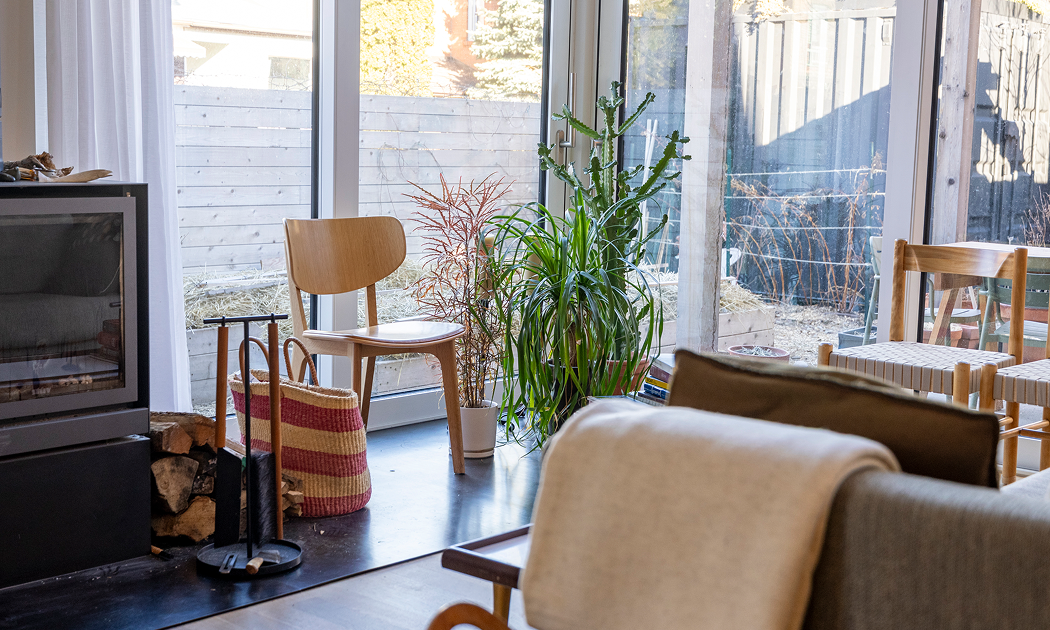
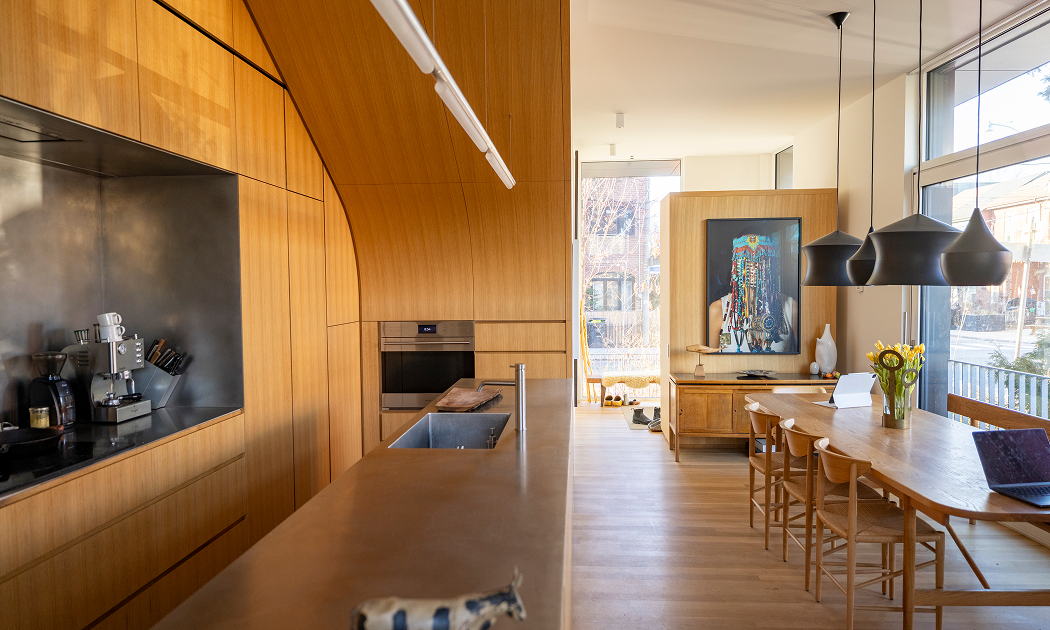

Levitt and Goodman make an unconventional pair of property developers. Partners in life and work, they are co-founders of Toronto-based LGA Architectural Partners. While they have designed everything from bespoke family homes to women’s shelters and affordable apartment buildings, Ulster House presented a new type of challenge: the opportunity to become developers.
The project was made possible by a recent municipal policy change to allow multi-unit housing in residential areas, Levitt says. Until about three years ago, small-scale multiplex development in single-family zones was not permitted, “making it a very risky proposition.” In 2023, however, a Toronto initiative called Expanding Housing Options in Neighbourhoods (EHON) liberalized single-family zoning to allow multiplex development on small lots, dovetailing with recent permissions for secondary dwellings in laneways and gardens. “Since the EHON initiative, we are seeing more and more come onto the market,” says Levitt.
Similar changes are playing out across the country, catalyzed by a two-pronged federal push for missing middle housing that combines incentives for municipal zoning reform with low-cost financing for small-scale developers. Administered by the Canada Mortgage and Housing Corporation (CMHC), the federal government’s $4.8-billion Housing Accelerator Fund offers Canadian municipalities funding in exchange for increasing housing supply by removing barriers such as exclusionary zoning and simplifying approvals.
In Regina, four-storey buildings are now permitted near frequent transit, with the same heights approved in parts of Charlottetown. In Edmonton, some residential neighbourhoods now allow up to eight storeys, while buildings with three storeys and up to eight units were permitted even before the federal incentives kicked in. In Vancouver, a blanket multiplex rezoning policy in 2023 was followed by a late 2025 bylaw that allows property owners along the burgeoning Broadway and Cambie corridor to bypass the zoning process entirely.
Calgary residents Kayla Browne and Nick Tumu began their citizen developer journey by building a new home and laneway house on a vacant parcel of land in 2019. The husband-and-wife team then used the modest profit to initiate a bigger development in the city’s historic Inglewood neighbourhood.
In contrast to the speculative investment that dominated the last two decades of urban development in major cities across Canada, their project is not primarily about turning a profit. For Browne, a leading local architect and founder of BOLD Workshop Architecture, housing is a passion project – and not a particularly lucrative one. “We’re doing this for the future,” she says. “I want to build the kind of city that I’d like to live in.”

On a long and narrow site that faces two streets, Browne and Tumu are trying to do that by developing a pair of eight-unit rental buildings, permitted under a blanket municipal rezoning plan approved in late 2024. With a playful yet contextually attuned design that picks up on elements of neighbourhood homes – like arched doorways and dormers – the planned New Monica complex is distinguished by its curves and pops of colour.
While zoning policy helped make the project legally possible, the CMHC’s MLI Select initiative is making it financially feasible. As Browne explains, the program, which was launched in 2022, “offers insurance incentives based on affordability, energy efficiency or accessibility” for new buildings. At New Monica, 40 per cent of the units will meet the CMHC’s definition of affordable rentals, she says. To help finance projects, the MLI Select program unlocks up to 50-year amortizations and lower insurance premiums, as well as up to 95 per cent loan-to-value ratios, necessitating only a five per cent down payment.
Noam Hazan, a Toronto-based architect specializing in missing middle projects, notes a palpable surge of small-scale multiplex developers among his clients, who range from boutique real estate professionals to growing families planning for multigenerational living. In fact, Hazan is getting involved himself, as part owner and developer of a multiplex in Toronto’s Fairbank neighbourhood, a vibrant, multi-ethnic community served by the recent completion of the city’s long-awaited Eglinton Crosstown light-rail transit line. Like many of his ongoing design projects, the plan entails a fourplex and a garden suite (or secondary dwelling).
“For people looking to get MLI Select financing, you need at least five units, which is why we’re seeing so many of these four-plus-ones across the city,” he notes. And in contrast to Toronto’s shoebox condos, the rental development offers family-oriented three-bedroom homes.
Citizen developers aren’t equipped to solve the housing crisis singlehandedly. Canada currently lacks about 4.4 million affordable homes – three million for people with low incomes and 1.4 million for those with moderate incomes – according to CMHC statistics. But they can help.
To make a meaningful difference, though, the future of citizen development must evolve to include people who aren’t specialized professionals like Levitt, Goodman, Browne and Hazan, who all boast expertise in architecture and planning. To this end, Levitt and Goodman’s LGA Architectural Partners also led the development of CMHC’s national Housing Design Catalogue, which – in principle, at least – equips homeowners with shovel-ready designs for secondary suites and multiplexes that fit standard lots.
Published in late 2025, the catalogue comprises plans by acclaimed designers from across the country, with designs adapted to each region’s building code and climate. In the northern territories, for example, multiplexes and secondary suites are designed to sit atop the permafrost and connect to septic services. For the Prairies, meanwhile, the designs take advantage of the relatively wide urban lots typical in Saskatoon, Regina and Winnipeg.
In Toronto, meanwhile, the ReHousing initiative aims to empower citizen developers by providing simple tools and guidelines for non-experts. Led by Levitt and housing researchers Michael Piper and Samantha Eby, the project began as a public research venture in 2022, recently evolving into an online toolkit for adapting the city’s most common housing types.
At the most modest end of the scale, it starts with design templates for interior renovations that fit within a building’s existing footprint, scaling up to additions, accessory dwellings and small apartment buildings.
“If you're a homeowner wanting to add a unit to your house, you may not know how much it costs. Maybe you don't even really know who to ask to figure out how much it costs, or you're not sure where to go to check to see if what you want to build is legal or not,” says Piper, laying out common use cases.
When I go on the website and type in my own address, ReHousing’s info tool draws from municipal databases to provide parameters that prove surprisingly accurate: it replicates my semi-detached Toronto house to within inches. I feed it some additional detail about the state of the property and my modest budget and it recommends a small rear addition, creating a second unit at a cost of about $50,000.
Suddenly, the notion of becoming a “citizen developer” seems less daunting. As Piper reminds me, anyone who’s built a separate entrance to create a basement apartment – which was legalized in Toronto at the turn of the millennium – is already a citizen developer. Taking the next steps just means thinking bigger.
Yet Levitt, Goodman, Browne and Tumu’s experiences all combine inspiration with cautionary tales. Even the seemingly routine process of getting Toronto’s Ulster House hooked up to the municipal power grid with new breaker panels entailed months of delays and an eventual price tag of $75,000, Goodman says, due to what utility providers deem the “non-standard” nature of multiplex dwellings.

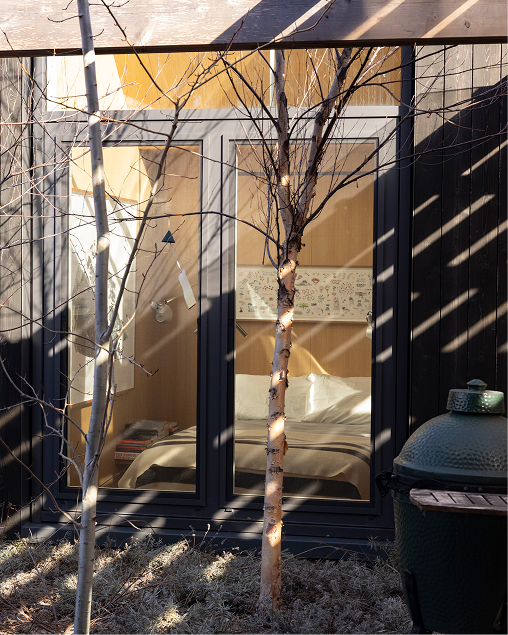
While the process reflects a municipal bureaucracy too slow to adapt to the realities of new density, Browne and Tumu’s challenges point to deeper political tensions. The 16-unit New Monica project has faced extensive public scrutiny, including from its immediate neighbours.
“In Calgary, anyone can appeal anything,” says Browne, bemoaning a lengthy judicial hearing relative to a complaint about the project’s planned bike stalls.
For Tumu, a petroleum engineer, the complex process invited comparisons to one of Canada’s most highly regulated industries: oil and gas. “Our project is designated as a ‘permitted use,’ yet we still have to get neighbour consent, and we still have to go through an appeals process. The city is saying you can build something of this scale in this space, but you can’t actually go and do it,” he says.
The protracted and sometimes self-contradictory planning process has delayed the start of construction by over a year, Browne adds.
Even some of the progress already made risks being reversed. Calgary's landmark upzoning policy approved in 2024 now faces a likely repeal, with a pivotal public hearing scheduled for March 23. Meanwhile, a Toronto plan to allow citywide six-plex construction was watered down to encompass just 10 of 25 municipal wards in late 2025, with opponents citing new strains on community infrastructure, parking and property values.
According to critics in both cities, such moves risk a rollback of the substantial Housing Accelerator Fund money the municipalities received from the federal government.
It’s no coincidence that the push for housing is strongest at the federal level, diluting as it’s digested into provincial and – especially – municipal bureaucracies. In 2026, it’s reasonably easy for Canadians of all political stripes to agree we need to build homes, though the proposition inevitably becomes more contentious as new density approaches our own neighbourhoods. The closer it gets to our backyards, the less we tend to like it.
These reflexive instincts have pushed politicians in many Canadian cities to scale back housing ambitions, insulating their constituencies from change. It necessitates an uncomfortable public conversation about how much local control over our cities, neighbourhoods and streets we’re willing to cede for a broader civic good.
Empowering citizen development and missing middle housing doesn’t always come at the expense of local priorities. For Inge Roecker, a German-born architect and University of British Columbia professor, community-led citizen development is nothing new.
“In Germany, people regularly come together for the purpose of building homes,” she says, explaining that “baugruppen” – or building groups – “effectively cut traditional developers out of the building process, frequently resulting in more affordable homes.”
Emerging in response to escalating housing costs in the 1990s, the baugruppen model quickly gathered momentum across Germany, with some 1,800 projects completed between 2010 and 2020. The groups may form based on a shared neighbourhood or common goals, such as sustainable housing or multigenerational living. Oftentimes, however, it’s just about saving money.
Roecker, a citizen developer herself, designed and built an eight-storey, 26-unit development called East Georgia Flats in Vancouver’s historic Chinatown in 2011. More recently, she is devoting her energies to bringing the baugruppen model to Canada and is set to publish “a graphic field guide to give people ideas about how to build these types of projects.”
Drawing on examples from Germany, Switzerland and Australia, the project aims to empower prospective citizen developers to work with friends, neighbours and family members to build housing at a collective scale, all without a traditional developer. “We’re getting momentum,” says Roecker. “People are starting to realize we have to do things differently.”