Across the country, mini and modular homes are emerging as a go-to solution to address affordability, homelessness, overcrowding and sustainable development.
In Kirkland Lake, Ont., a non-profit Indigenous women’s group is building a factory that will manufacture wall and roof panels out of sustainable materials for houses that can withstand the harshest Canadian winters.
In Sydney, N.S., a “homeless shelter of the future” – a village of 35 mini one-room houses – has sprung up to provide transitional housing.
And across British Columbia, local governments are rewriting zoning laws and reinterpreting building codes to legalize tiny houses on wheels.
Building homes, or parts of homes, in a factory and then assembling them on site has the potential to speed up project timelines and cut costs. Modular construction, also known as prefabrication, is a key element in the federal government’s strategy to roughly double the housing industry’s output to 500,000 starts a year.
Many Canadian communities are charging ahead with their own ideas of how best to apply these promising building methods. Some are even challenging conventional notions of what makes a home a home. Here, we delve into a few of the most original initiatives underway.
The people’s place of building
Kirkland Lake, Ont.
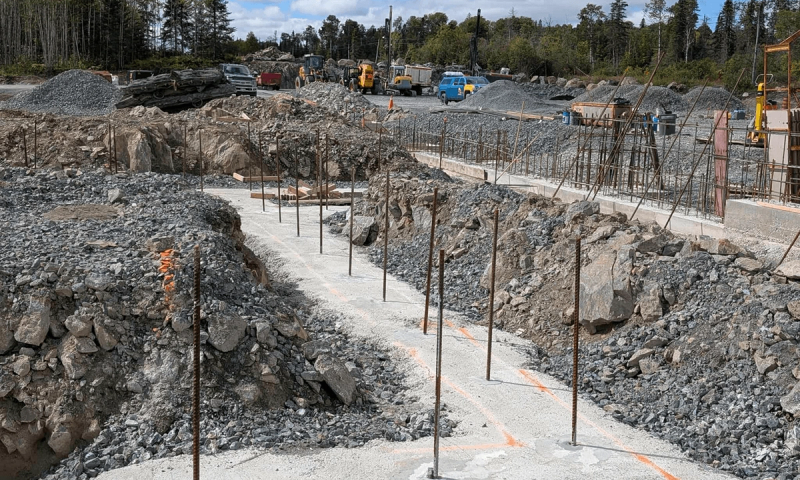
One overcast morning in January, Colleen Carpenter took a detour on her way to work to visit the site of the modular home factory being built just south of Kirkland Lake, a town of about 8,000 in northeastern Ontario. The steel structure for the main, 24,000 sq. ft. building was nearly complete. Construction crews were at work on the snow-covered roof of Anishnawbe G’Zhiitoonegamic, which translates to the “people’s place of building.” “Seeing it, I cried,” says Carpenter, who took part in a pilot project that led to plans for the factory. “I was overwhelmed, and it was still so surreal that this happened.”
It’s hoped that after it’s finished, the factory will eventually produce up to 200 homes a year − sustainable and energy-efficient dwellings designed for and built by Indigenous women. Homes built in panels, like LEGO blocks, that you could lay flat on the back of a truck trailer and then assemble in days. Homes to alleviate the overcrowding and unsafe living conditions endured by many Indigenous people in the North. Homes just like the one Carpenter had left that morning, the one that provided the sense of security and access to the wilderness that the 39-year-old single mother had long dreamed of.
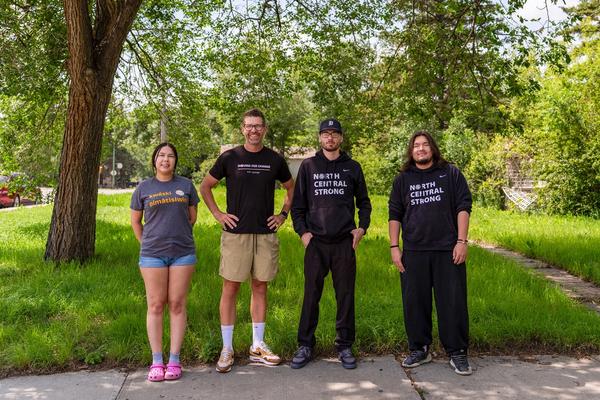
Carpenter is a program facilitator with Keepers of the Circle, a non-profit based out of Kirkland Lake that supports and advocates for Indigenous women across Ontario. She coaches them on how to envision a better future and then make a plan to get there. “I want to help my people thrive and move forward and take on life, as scary as it is nowadays, especially for us Indigenous women,” she says.
Skills training and career planning are central to its mandate, but Keepers of the Circle also provides child care and youth programming, and oversees two Indigenous primary health-care teams. The group is on alert for new ways to serve its community, which is how Carpenter ended up learning how to build her own off-grid, 480 sq. ft. cabin with a company that specializes in prefabricated panels for passive homes, a type of energy-efficient design that needs minimal heating or cooling to maintain a comfortable temperature year-round.
The Keepers got funding through the Housing Supply Challenge, a program run by the Canada Mortgage and Housing Corporation (CMHC), for a pilot project in 2022 to send Carpenter and five other Indigenous women to be trained in a factory in southern Ontario. They spent two months in Baysville at a facility run by Tooketree Passive Homes learning how to build the panels.
It took them three days in January 2023, during a blizzard and a cold snap that got below minus 40, to assemble the house on Carpenter’s seven-acre parcel of forested land south of Kirkland Lake. “We were all out working hard in like no-seeing conditions,” she says. “It was kind of scary, but we did it. And, like, what a way to show northerners that you can build in a winter.”
The Housing Supply Challenge started in 2020 and has provided $300 million to manifold companies, researchers and community organizations across Canada to encourage new solutions for affordable housing. The success of the Keepers’ pilot made it eligible for additional funding to scale up the project and manifest the dream of a modular home factory in Kirkland Lake. Bertha Cormier, executive director of the Indigenous group, says it received $10 million from CMHC to help fund the roughly $20 million facility.
Build Canada Homes, a new federal agency, has identified modular home construction as a key strategy for increasing the country’s housing supply. A 2019 report from McKinsey & Company highlighted the potential of factory-built houses to speed up construction timelines by 20 to 50 per cent and save up to 20 per cent in costs. The Housing Supply Challenge funded other organizations looking to utilize modular housing in the North. Sakku Innovative Building Solutions, for example, is building the first Inuit-owned and -operated modular housing factory and training centre in Arviat, Nunavut. Producing homes on a factory assembly line and then trucking them to the building site helps address northern-specific challenges, such as a shortage of tradespeople, limited access to materials, high costs and a short construction season.
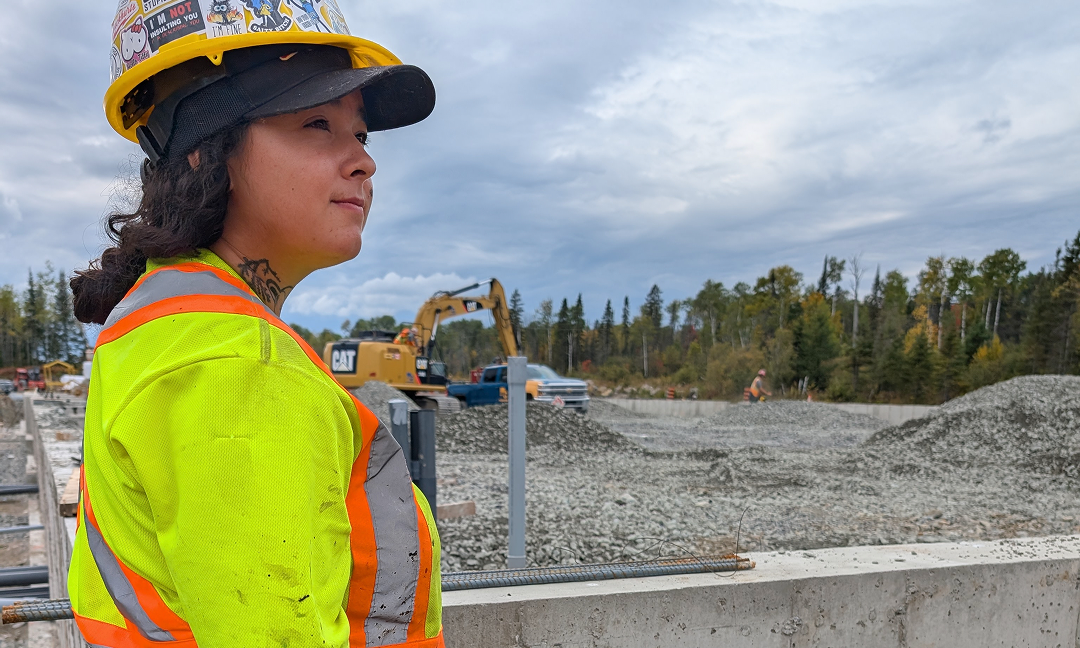
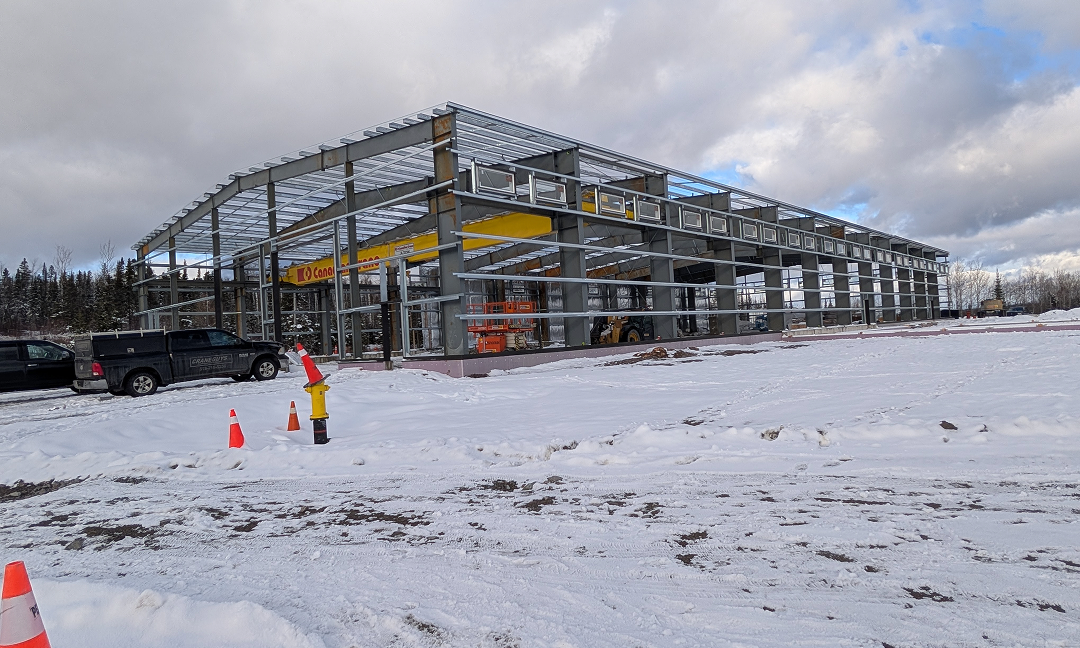
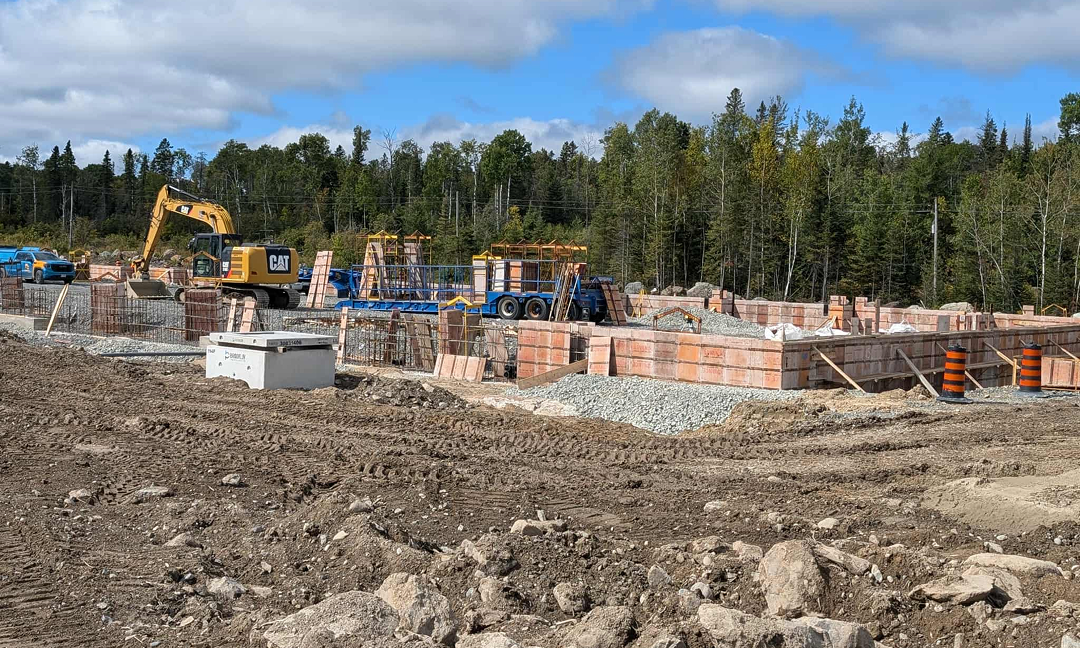
Anishnawbe G’Zhiitoonegamic is on track to be up and running by July 2026. The technology used in the factory can be programmed for a variety of floor plans. One ready-to-order design was created by the Native Women’s Association of Canada to meet the needs of Indigenous women and girls and includes cultural elements such as a free-standing wood stove and space for multigenerational living.
As for the sustainable materials used for the panels produced by the factory, Cormier says, “As an Indigenous organization...it’s our way of doing our share of ensuring that there is going to be something available for the seven generations ahead.” The Keepers will offer discounts for Indigenous people but plan to market the homes widely and run the factory as a business. The hope is to implement some kind of profit-sharing with employees.
A 10,000 sq. ft. administration building, attached to the main factory, will house a daycare, showroom and six small apartments for female employees and trainees. There’s also a cultural room. “Our girls really emphasized the need for that morning smudge,” Cormier says. “It kind of helps the women prepare for their workday and leave their home life at home.”
Carpenter is from the Attawapiskat First Nation in northern Ontario. Her parents were residential school survivors, and the family struggled when she was young. She remembers living in an abandoned cabin on the outskirts of Timmins and a tent on the fringes of Thunder Bay. Despite the challenges, her parents taught Carpenter and her two sisters how to hunt and trap and live off the land. “I grew up feeling more at home in the bush,” she says. “That’s why I resonate with the off-grid life.”
The new house has empowered Carpenter to pass on her traditions to her daughter, who is in her early 20s and lives close by. She recently taught her how to snare a rabbit and plans to take her spear-fishing on a nearby river this spring.
The cabin in the woods might have a tiny footprint, but it marks the start of a big new chapter for Carpenter and for Keepers of the Circle. “I never thought I would own a home,” she says. “So, to be part of something like this, I hope it creates inspiration for others to just continue to dream.”
The dignity of a locking front door
Cape Breton, Nova Scotia
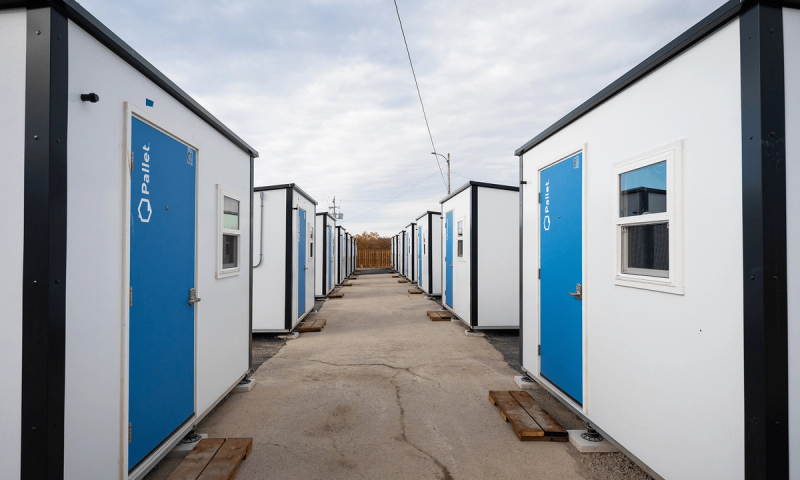
Seventy-two square feet may seem awfully tiny for a home, but it’s enough for a built-in bed, desk and shelves. And most importantly, a door. When Charles Jackson first opened it a few years ago, he was among the first to move into one of the 35 shelters at the Village at Pine Tree Park on the outskirts of Sydney on Cape Breton Island. “I loved the fact that I had my own little hut that I could stay in and lock the door,” he says. “I had heat. I had power. There was Wi-Fi so I could search the web.”
He settled at Pine Tree after living in his car for five months during the summer and fall of 2024. The 57-year-old father of two had lost his job during the pandemic. The stress exacerbated a chronic health condition, and he had difficulty finding other work. His mental health, and his relationship with his wife of 34 years, deteriorated. She asked him to leave in July that year. He got in his car and drove away, not exactly sure where he was going or what he would do.
Jackson learned that it was safer to sleep during the day. He looked for places that were busy, places with a lot of lights, before it got dark. He often parked at a gas station, one with a sympathetic manager. Jackson got the call about his new place at Pine Tree as the temperature started to drop. “The winter was coming, and so I was ... pretty lucky to get into the shelter. I was so grateful. You have no idea.”
Erika Shea, the CEO of New Dawn, the non-profit that built the village, calls Pine Tree the homeless shelter of the future. “One of the reasons why people sleep in tents is they don’t want to go to a congregate shelter,” she says. “They don’t feel safe. They’ve had difficult experiences.” Shea notes that people sleeping in the same room as dozens of other strangers often lie down on top of their belongings because they worry about being robbed.
The simple technology of a door with a lock affords privacy, dignity and security. You can let your guard down, catch your breath. “It’s about helping people get to a place that their minds and nervous systems can even think about what comes next,” Shea notes.
At Pine Tree, a large building next to the orderly rows of white cabins with bright blue doors holds the bathroom and shower facilities, laundry, kitchen and common room with tables and chairs.
The goal is to find people stable, permanent housing within six months. Three support workers from the Ally Centre, a social service agency, are on site at all times. Health professionals visit regularly. Programs include resources for addictions, anger management courses, art therapy and employment services. The province provides a full-time housing support worker.
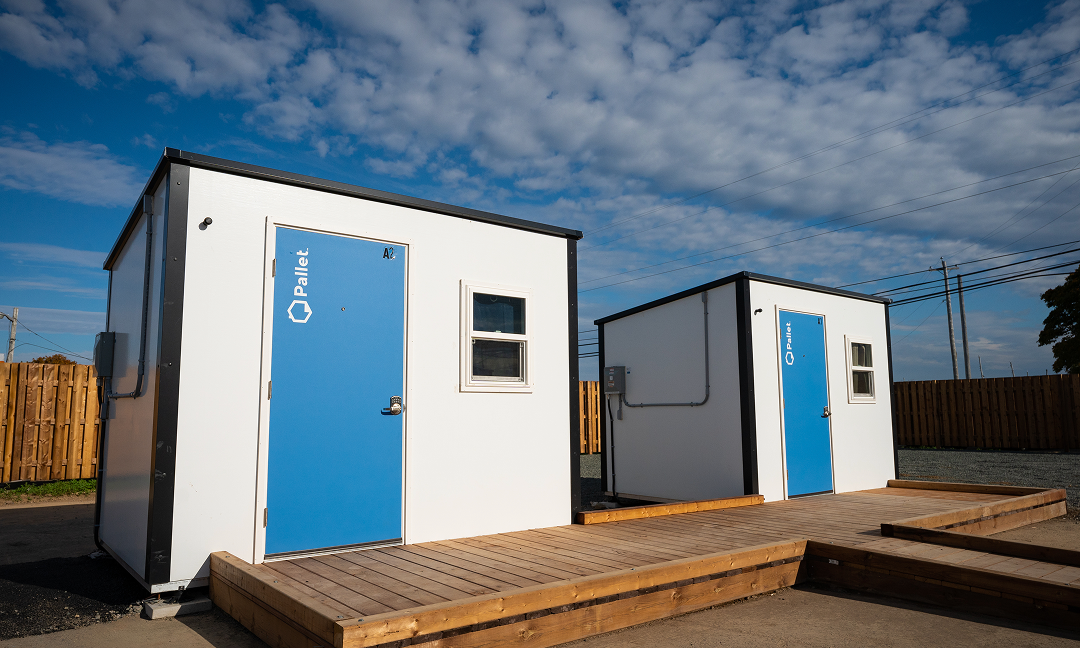
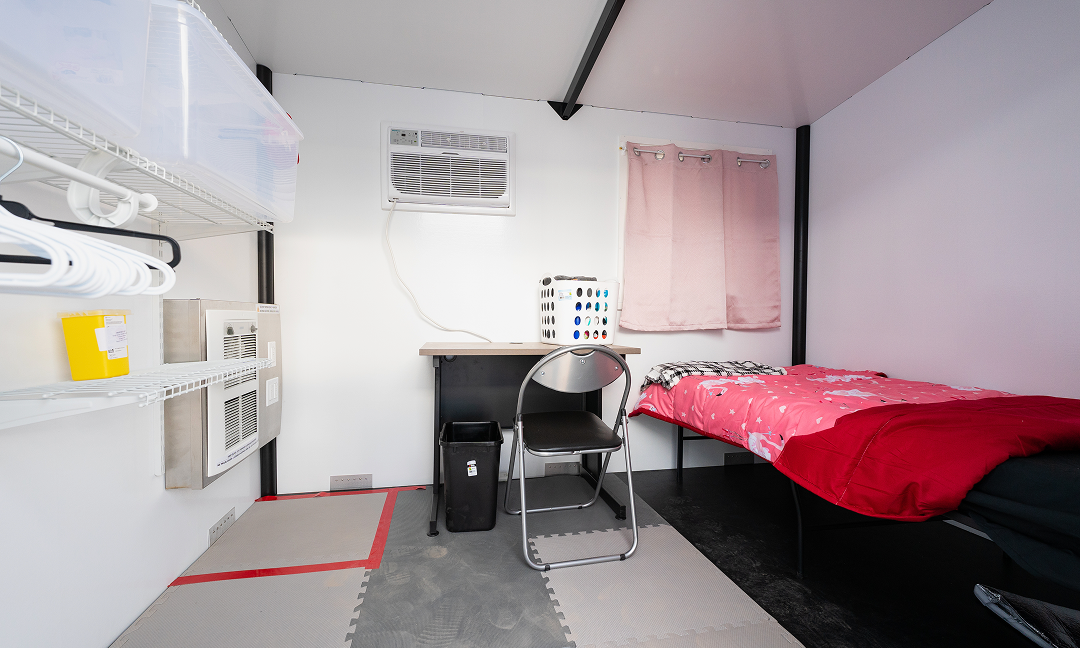
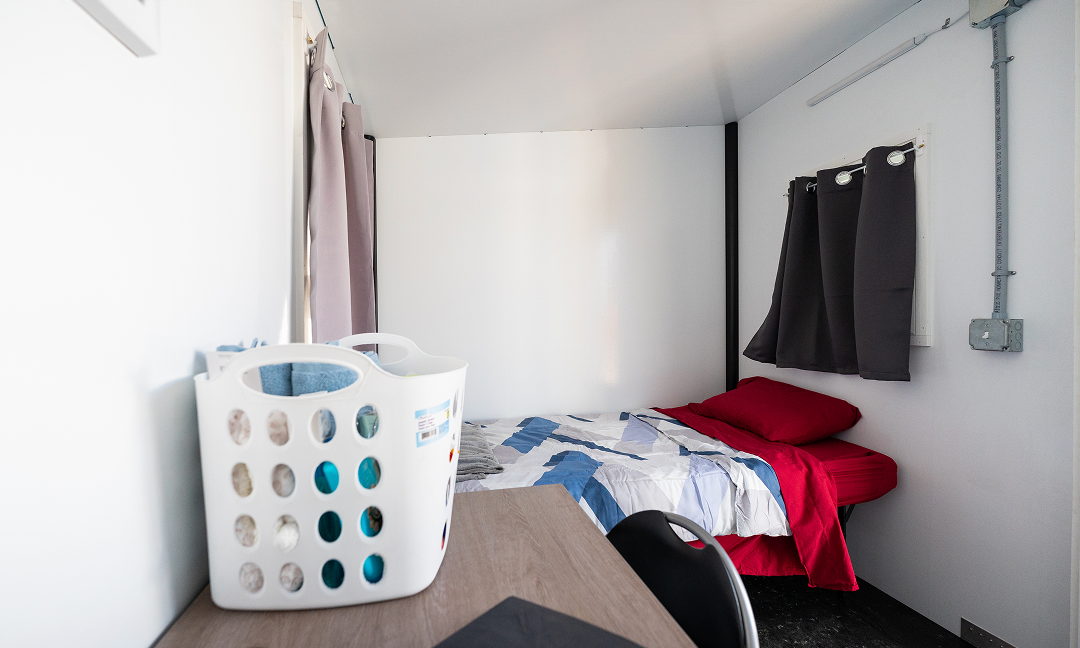
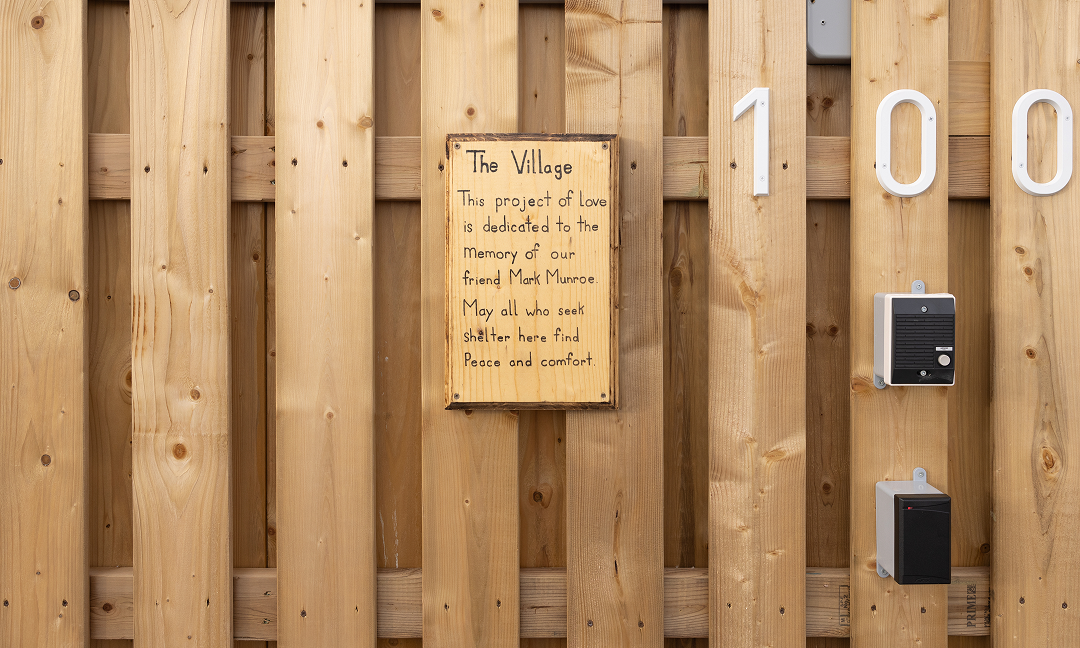
In 2023, the government of Nova Scotia bought 200 of the prefabricated shelters, which can be put up or taken down in less than an hour from U.S. company Pallet, for $7.5 million. Pine Tree is one of six such villages in the province. Shea says homelessness increased dramatically during and after the pandemic. The number of people without homes in the Cape Breton Regional Municipality more than doubled within a few years, from 200 to 500 out of a population of 80,000. “It was the intersection of a growing mental health and addictions crisis and the rising cost of housing, and those things happening simultaneously.”
Sydney is not a big city and people were unfamiliar with that level of visible homelessness. Shea says it’s been a crash course for the community about why this happens and the best ways to address it. Provincial government officials first proposed a location for the shelter village closer to downtown. Shea remembers a heated public meeting in early 2024. “It was clear pretty early on that we were arguing with people’s imaginations. All of the things that they were most scared of we knew were never going to happen.”
Still, paramedics and the police have responded to more calls at Pine Tree since the shelter opened. The village is on an 80-acre property owned by New Dawn that includes a housing facility for people with disabilities, 28 detached homes, a mobile home park and a curling club. “Many of the people who join us at the village are dealing with mental health and addictions difficulties that can make clear thinking and emotional regulation really hard,” Shea says. Staff have learned that they can’t help everybody. There’s a zero-tolerance policy for violence and aggression. Last August, one resident attacked another with a kitchen knife. Both men were evicted. New Dawn runs a Good Neighbours Committee that meets quarterly with the public and in the aftermath of a crisis.
More villages like the one at Pine Tree Park are springing up across the country. The philanthropist Marcel LeBrun and his organization 12 Neighbours have started four in New Brunswick − one in Fredericton and three in Saint John.
The biggest challenge to the success of transitional housing is a shortage of places to move people to after they get back on their feet. Most residents at Pine Tree need some kind of help to live on their own. “More options around long-term supportive housing are, we believe, how we get out of this homelessness crisis,” Shea says. New Dawn opened a 25-unit supportive housing facility in Sydney last May and is building eight tiny homes, larger units with their own kitchens and bathrooms, at Pine Tree Park.
About 110 people have lived in one of the 35 Pallet shelters in the first 18 months of operation. Jackson is one of 50 who found a new residence. He moved into a one-bedroom basement apartment in a house in July 2025. “I got my own doorbell and my own door down below, so it’s private and it’s quiet and it’s clean,” he says. “I loved it the minute I saw it.”
Tiny homes on wheels
British Columbia
It took a one-day meeting in Nanaimo, B.C., last year to achieve a breakthrough in the tiny home movement. Municipal planners, inspectors, builders, bylaw officers, utility experts and one international specialist in rainwater catchment systems got together to address a pressing housing dilemma. How could the more than 460 islands in the Salish Sea between the southern half of Vancouver Island and the mainland create more options for affordable housing, especially for those who work in the grocery stores, gas stations and restaurants that serve the region’s 25,000 or so inhabitants? One promising answer was tiny homes on wheels, but the sturdy little dwellings were not yet considered legal for year-round living.
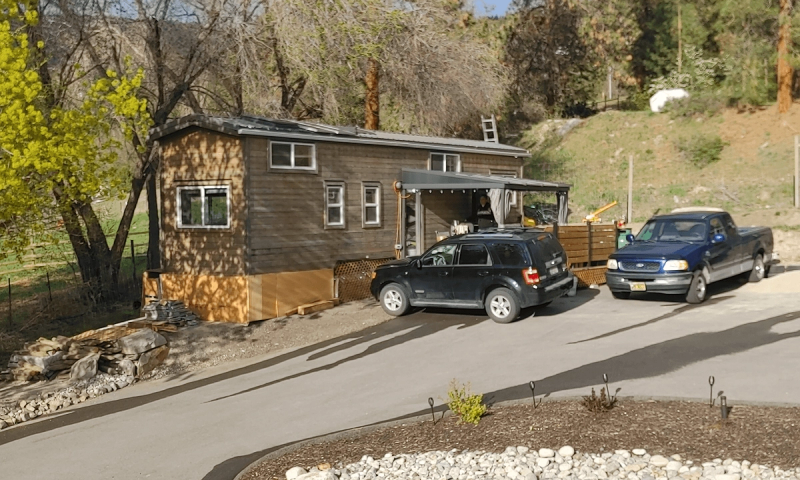
Some tiny homes are built on conventional foundations, others on a trailer chassis with wheels so they’re easy to move. Both are designed for all-season living and contain most of what regular-sized houses have. Often, they even look like them, with peaked roofs and modern finishes.
Vanessa Craig, an elected official with the Regional District of Nanaimo (RDN), describes how the wheels have had an outsized influence on how people perceive such dwellings. Builders had defaulted to using the national building standard for recreational vehicles, which meant municipalities across Canada treated them like RVs. And few places allow people to live in RVs year-round.
Attendees at the Nanaimo meeting realized that the tiny home builders among them were already close to Canadian Standards Association rules for manufactured homes, which include beefier requirements for things such as structural integrity, fire safety and energy efficiency. The building inspectors in the room explained that they could issue permits for manufactured homes, even if those homes were on wheels. “That was a real breakthrough,” says Craig.
This kind of portable home still needs to be fixed to a foundation and connected to local utilities. But that can be achieved by driving piles into the ground and then bolting or welding them to the house’s frame. Such a foundation has a minimal impact on the land and is easy to take apart if the homeowner decides to pull up stakes.
The light-on-the-landscape aspect of tiny homes on wheels is appealing to Tobi Elliot and her colleagues on the Islands Trust, the body responsible for protecting the ecological integrity and unique nature of the Salish Sea islands (she is the trustee for Gabriola, DeCourcy and Mudge). These islands have a unique government structure. Seven regional districts, including the one from Nanaimo, are responsible for providing services such as waste removal, utilities and building inspection. The 13 local trust committees take care of bigger-picture planning, land-use bylaws and zoning.
Their policies have succeeded at protecting the natural beauty of the islands but exacerbated the housing crisis by safeguarding large lot sizes at the expense of density. It’s become difficult for older adults to downsize and stay in the community. Young families and people who work in the shops have fewer and fewer options for rentals. “They’re living in increasingly unsafe and sort of under-the-radar types of housing,” Elliot says.
Islands Trust officials have known for years that tiny homes on wheels could help diversify the housing supply. “I think we broke through on the certification standard piece − that was a really big step forward,” Elliot says of the Nanaimo gathering. The ability to issue permits makes it easier to approve the tiny homes on wheels already in use on the islands. Another step is to look at how to incorporate this new type of housing into the Official Community Plans and zoning bylaws, something Mayne Island has done.
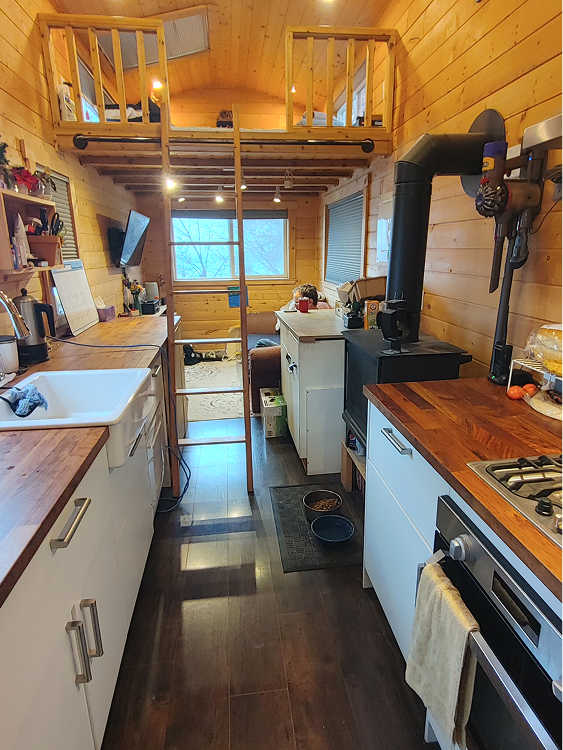
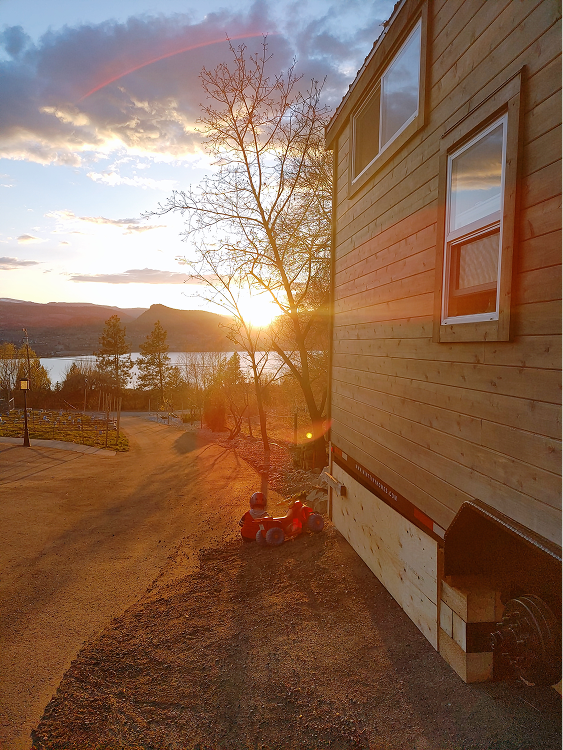
The work by Islands Trust and the RDN has charted a course for other jurisdictions across Canada looking to increase options for affordable housing. A few places have already made the move. Grand Forks, a town of about 4,000 in B.C.’s southern Interior, changed its bylaws in 2018 to allow tiny homes on wheels as year-round residences. The Bluegrass Meadows Micro Village, created in 2015 to address a housing shortage in Terrace, B.C., has about 60 of these small dwellings. Rent for a tiny home pad goes for $750 a month.
Adrienne Fedrigo has been closely monitoring the work by the Islands Trust and RDN. She lives in Naramata, a small town flanked by vineyards on the shores of B.C.’s Lake Okanagan. She’s considering taking her 400 sq. ft. home on wheels, which she bought in 2020 for $130,000, to a local builder to see how much work it needs to bring it in line with the manufactured-home version of the CSA standard. “That would give me a whole other host of opportunities, [like] being able to find a larger parcel to put it on as a secondary home or even bring it back for a temporary use permit, but as a manufactured home,” Fedrigo says.
She had been living in her tiny home with her former partner and two young sons for three years before they received the dreaded letter that it was bylaw non-compliant. It’s still parked on her parents’ half-acre property in town and being used as a storage shed.
Fedrigo is the elected representative for Naramata within the Regional District of Okanagan-Similkameen and the president of the Tiny Home Builders Association of Canada. She’s a member of a task group working on recommendations for how to incorporate tiny homes into the national building code. And she is optimistic that within the next few years, more local governments will have the tools they need to issue permits for tiny homes on wheels as permanent dwellings.
Part of the appeal for Fedrigo and her family of going tiny was affordability. But it was mostly about the lifestyle. “I like the coziness of the space,” she says. “You just kind of feel like your house is hugging you.”