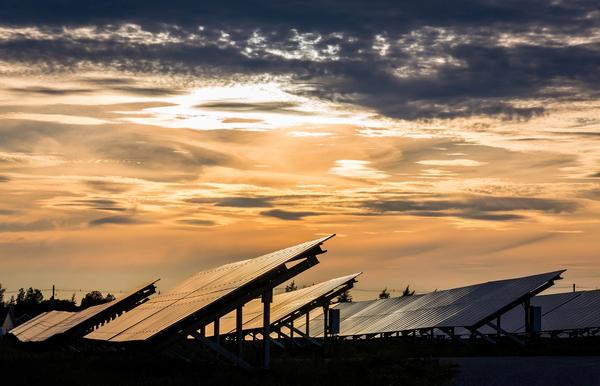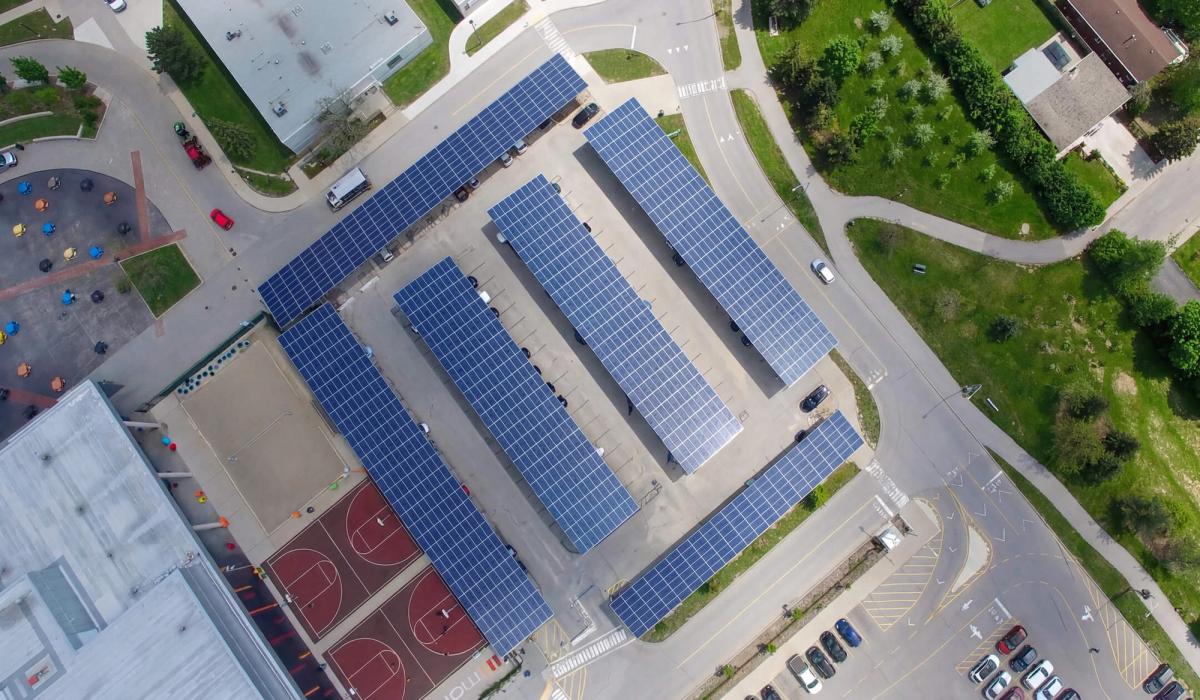
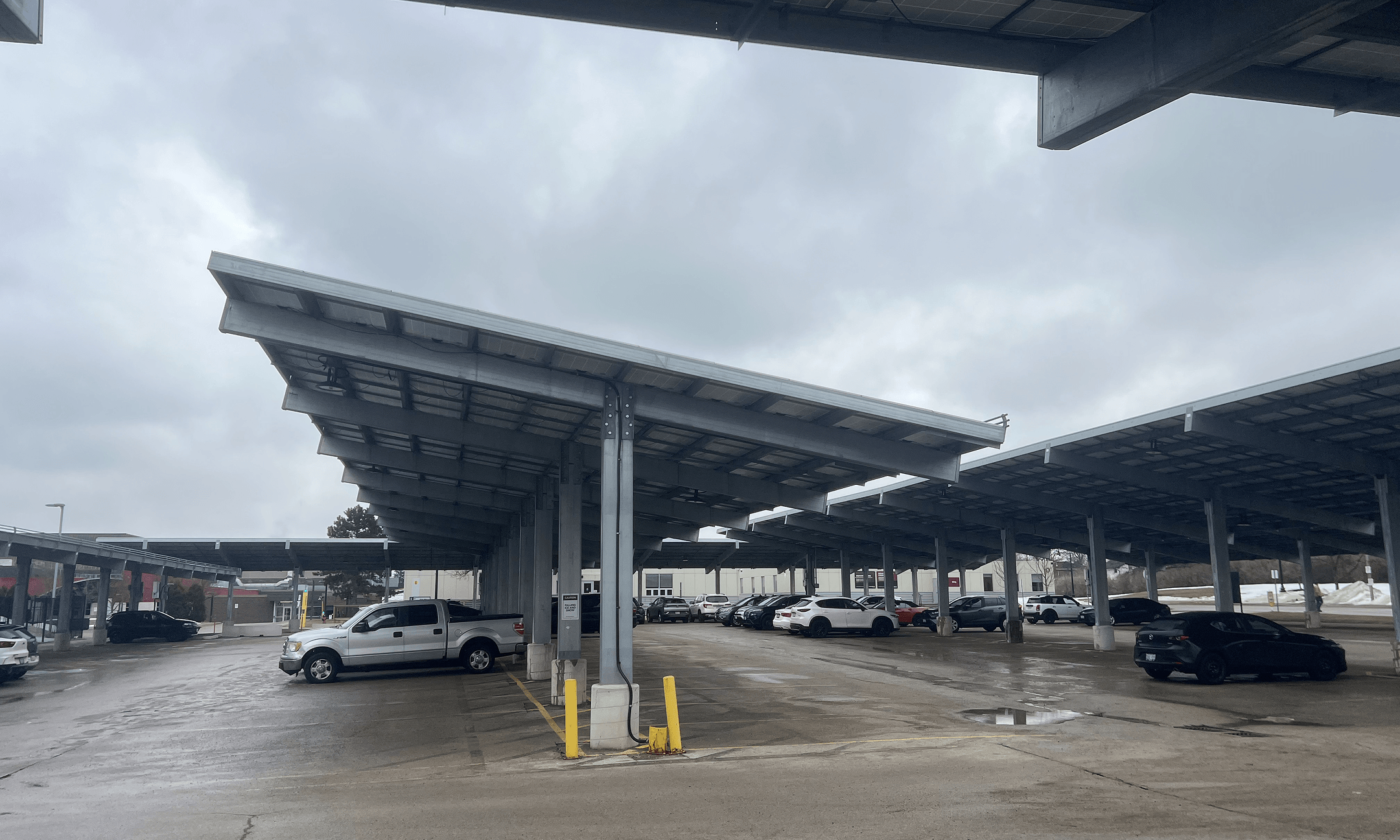
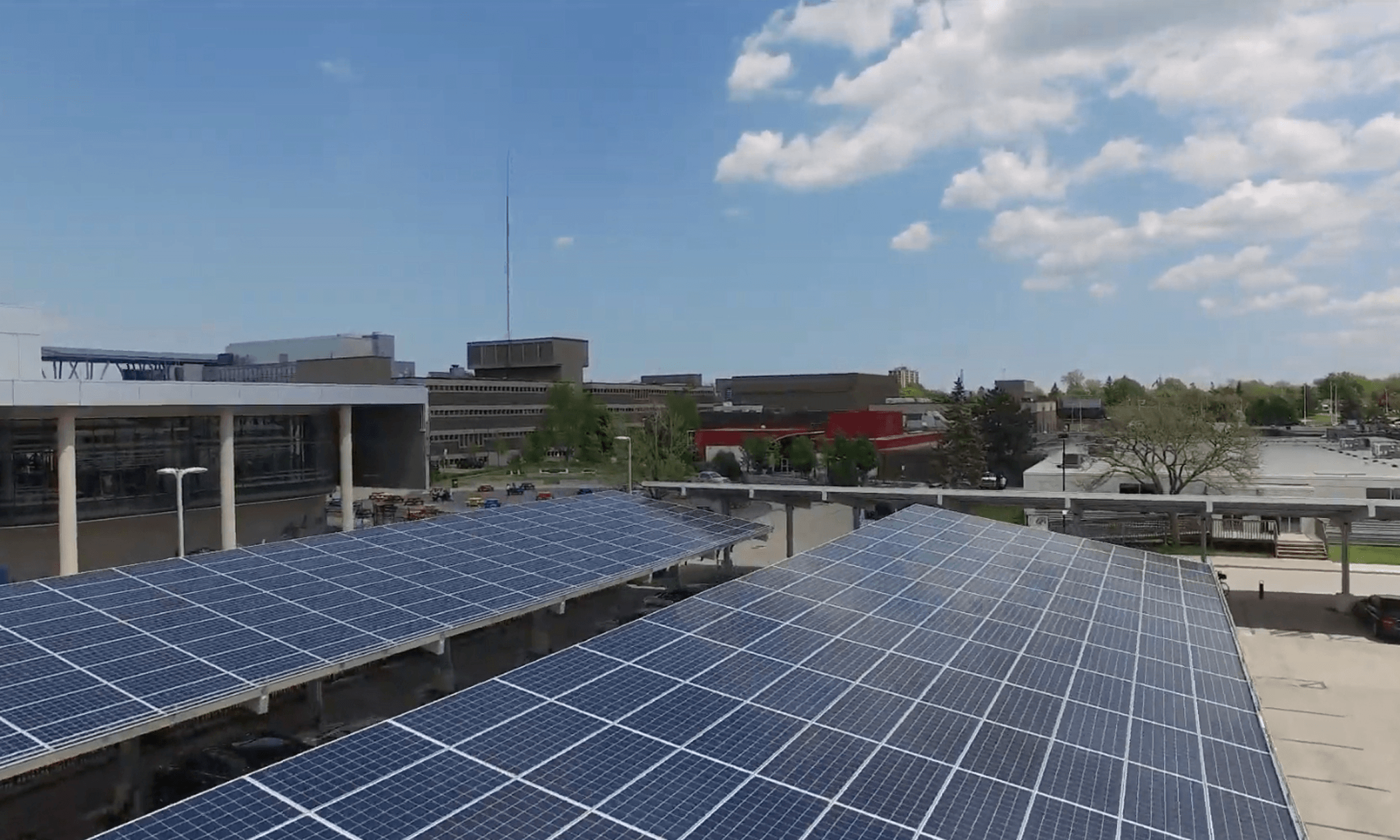
At Mohawk College in Hamilton, next to the gym where students shed their heavy winter layers before working out, there are four rows of sleek, almost sci-fi-looking structures. Steel pillars rise to support tilted, solar-panelled roofing shielding some 40 cars – each open-air structure can accommodate 25 – and a few dishevelled students after a sudden burst of freezing rain. From a low angle, it might not look like much: just another parking lot in a city full of too many. But if you tore this one up and planted a two-acre forest in its place, it would reduce carbon emissions by the same amount. This solar carport, the largest in Ontario, helps keep the lights on in that gym.
Solar photovoltaic carports or canopies (the “photovoltaic,” or PV, denotes the conversion of sunlight into electricity) are exactly what they sound like: parking lots shaded by canopies covered with hundreds, sometimes thousands, of solar panels.
The benefits are plenty. They generate clean energy on underused land, cut carbon emissions, mitigate urban heat islands, power EV charging stations and protect cars from the weather – on top of having the Space Age allure of something pulled from The Jetsons. They’re already old news in France, where any lot bigger than 10,000 square metres has to be retrofitted with solar panels by July, and in South Korea, which mandated a similar thing last November. They’re big in sunny California, where one-third of the state’s electricity is solar-generated, and where returning to an unshaded car after 90 minutes in the gym could make you pass out.
Get our weekly newsletter – the people, places, and ideas revealing where Canada is headed.
And gradually, as Canada continues the rapid expansion of its solar footprint, they’re popping up across the country.
You’ll find the largest solar carport in the country at the Canadian Pacific Kansas City railway headquarters in Calgary. It fits 500 cars and cuts 2,600 tonnes of carbon emissions annually, the equivalent of pulling 570 automobiles off the street. In November, Toronto’s first net-zero community centre opened in Scarborough’s Morningside Heights, complete with solar panels on the roof, walls and canopies of the parking lot. Mostly, though, you’ll see them on college and university campuses – Northern Lakes College in Alberta, the University of British Columbia, Centennial College in Toronto – which typically have established net-zero commitments and can more easily access government funding to support construction.
In the race for Canada to be carbon neutral by 2050, experts say, solar carports are the cheapest, most pragmatic and handsomest next frontier.

“Canada has world-class research and training institutions with very advanced expertise on solar photovoltaic carports,” says Jose Etcheverry, an associate professor at Toronto’s York University and director of the International Renewable Energy Academy. In 2015, he helmed the York team that built one of Canada’s first solar canopies, a two-stall EV charging station on campus that relied entirely on local materials and labour. He was inspired, he says, by the ones he saw at the Nordic Folkecenter for Renewable Energy in Denmark in the early 2000s, but wanted to add his own key innovation: keeping it off the grid.
“We thought,” Etcheverry recalls, “what about installing a cabinet with a battery system inside of it, so that when the sun is shining and there’s no electric load, the electricity can be stored for things like voltage regulation – which is useful in case there’s a blackout.” It’s cheaper than building new gas plants and would have been helpful in July 2024 when a storm knocked out a transformer station in Toronto and stranded 170,000 people without power. “Ours was just a small-scale project that demonstrates the direction we could go with this.”
Canada is making crucial strides as a leader in specialized solar carport technology. Where the country once lagged behind, we now have the resources and world-class manufacturing for all the components: in Ontario, the steel can be sourced from Hamilton, screws can come from Guelph and – this is what Etcheverry is really excited about – the advanced batteries that could keep it all off-grid can now be sourced from Windsor, where NextStar Energy has expanded its operations to include production of energy-storage-system batteries that can support commercial and grid-scale solutions.
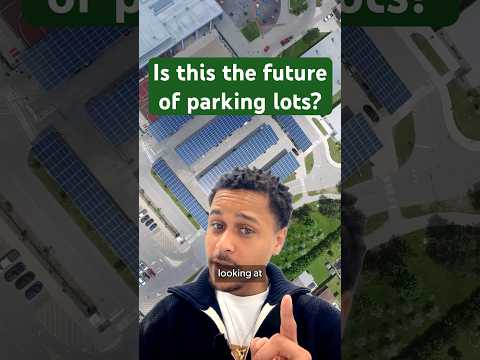
In 2024, an Ontario Clean Air Alliance report argued that covering just half of Toronto’s 7,000 open-air parking lots with solar panels could produce enough electricity to meet one-quarter of the entire city’s electricity needs while cutting city emissions by 1.9 megatonnes per year. “We already have a Canadian-made solution that increases environmental protection, security and job creation,” says Etcheverry. “What we now need are new policy mechanisms and better incentives to ensure these are installed in as many parking lots as possible.”
So, what’s the holdup?
“Generally, a carport is about two times the premium compared to, say, a rooftop installation,” says Zac Jolliffe, the business management developer at VCT Group. VCT got into the business of solar carports in 2018 when it helped make the rooftop arrays and carports at Waterloo, Ont.’s evolv1, Canada’s first zero-carbon building.
The good news is that the costs for solar have seen a dramatic downtrend during the past decade and a half. “You can build a whole carport for about what it cost just to buy the panels 15 years ago,” Jolliffe notes.
Canada is getting much closer to a reality where the country doesn’t have to rely so much on oil and gas, our leading source of GHG emissions. Meanwhile, the International Energy Agency reports that solar PV is now the cheapest source of electricity in history. Ed Cipriani, director of facility operations at Mohawk College, says that despite the high up-front cost, its solar carport – which opened in 2019 – reached payback around 2023. “It’s generating enough energy to power 50 to 55 houses in a year,” he says. “We’re saving about $150,000 to $160,000 a year.”
In the end, he says, it really turns out to be “a quick win.”