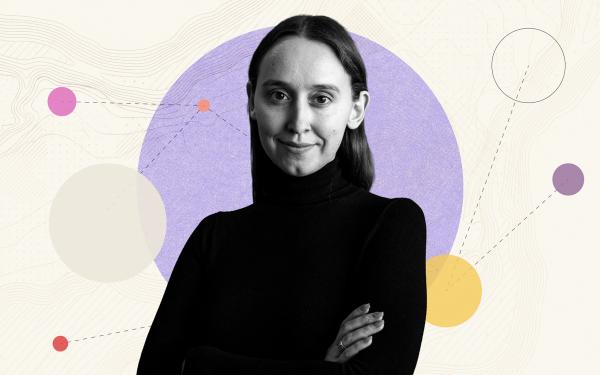
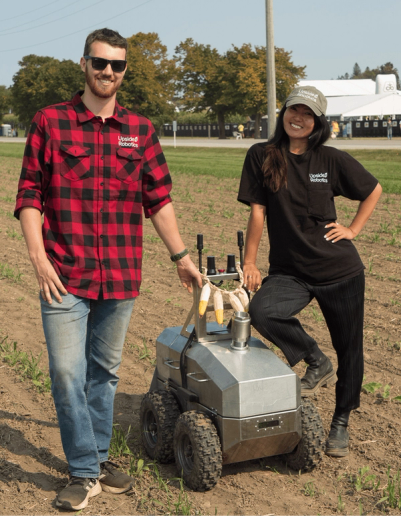
Jana Tian is the co-founder of Upside Robotics, an agri-tech startup in Waterloo, Ont., that uses robots to apply fertilizer more precisely, cutting costs while reducing environmental impact. Born in Slovenia and raised in London, U.K., Tian met her co-founder, Sam Dugan (a Canadian born and raised in Waterloo), at the Velocity incubator in San Francisco. She moved to Ontario when they decided it was the best place to launch the business. When they asked local farmers to put their faith in unproven innovation, the duo put their camper van where their mouth was: Tian and Dugan spent their first growing season sleeping in an RV so they could troubleshoot problems in real time. That first year, Upside Robotics had four clients. Today they work with 22 farms and have a waiting list of more than 200. With a fresh funding injection of US$7.5 million raised in February, they’re ready to ramp up to meet demand.
Here, in her own words, Tian reflects on building in Canada, earning trust in the field and thinking bigger about what comes next.
Home is where the talent pool is
We were in San Francisco when we launched Upside Robotics in February 2024, but we knew we wouldn’t stay there. The Bay Area is really focused on software because it’s so scalable, but it’s less suited to robotics. Even at top U.S. schools like Stanford or Berkeley, you tend to study computer science or mechanical engineering – software or hardware. At the University of Waterloo, there’s a mechatronics program where you can do both at once, which is incredibly important when you’re building robots. Waterloo also has an established hardware-software ecosystem, thanks to BlackBerry. There are a lot of manufacturers in the area; plus there are the Mennonites, who can weld pretty much anything you need – like the parts for our stainless steel robots.
Good things grow in Ontario
The Bay Area’s agriculture is mostly specialty crops like vineyards or small citrus orchards – it doesn’t really have row crops, which is where we saw the biggest opportunity for impact. Corn, for example, uses a significant percentage of global fertilizer, so if you can cut that in half you’re saving hundreds of billions of dollars. Ontario grows a lot of corn – around $2 billion worth a year. Canada is also further ahead than the U.S. in reaching its sustainability targets, with a mandate to reduce 30 per cent of fertilizer use by 2030. That’s great for sustainability, and great for us in terms of connecting with farmers who are going to have a real need for our product.
Precision with a purpose
Before Upside Robotics I was a food developer for Ben & Jerry’s, where I worked with growers to source ingredients. When I asked farmers about their sustainability metrics back then, it was just blank stares. The more time I spent in agriculture, the more I understood why: when you’re worried about feeding your family, sustainability can feel like a luxury. That realization changed the way I thought about the problem. If agriculture is going to hit sustainability targets while also improving profits and producing more food on limited land, farming has to become more precise. That’s when I met Sam, who was working on drones, and we started exploring whether that technology could be used for fertilizer application. But you have to hit the roots, not the leaves, so we eventually moved toward land-based robots.
When you can’t be reliable, be reliably transparent
When I went into agriculture everyone warned me farmers would be difficult to work with and slow to adopt new tech. My experience has been the opposite. Farmers are entrepreneurs, and they understand the realities of a startup. In our first year, we were about 20 per cent successful, meaning 80 per cent of what we promised didn’t happen. It was trial and error. You make all of these plans and then shit happens. And if there is one group of people who really get that, it’s farmers. We’d be out repairing robots in the field at 2 a.m. and the farmers were out there with us. We haven’t lost a single customer – not because everything has gone perfectly, but because we knew that trust was important and we established that with total transparency.
The abundance mindset is a must
In the U.S., farmers rely heavily on subsidies and can be less eager to experiment with new approaches. Canadian farmers are open to taking bigger swings. I wish I could say the same about the investment community, but fundraising in Canada is really tough. In the Bay Area, investors ask, “OK, how can we make this a billion-dollar company? A trillion-dollar company?” It’s an abundance mindset. In Canada, the first questions are, “What are your risks? How are you mitigating them? What’s going to go wrong?” As an entrepreneur, that’s not a great mindset. You have to be a little naive. You have to believe you might be the one.
Too sexy for this farm
The average age of a farmer in Canada is mid-50s. Many of their kids have left for university and don’t come back. So now you have this older generation who want to retire but they can’t pass on their farms because the next generation is in the city. My hope is that if we keep merging agriculture and technology, it’s going to make farming sexy again for young people. It’s farming, but it’s also engineering, it’s robotics, it’s AI. You’re not a farmer, you’re an agri-tech bro.
When in doubt, go cottagecore
When I moved here my Canadian co-founder told me that I had to start saying “eh” and wearing flannel. I’m not sure about the “eh,” but we chose a black-and-red-check button-down for our staff uniform. It’s a nod to Canada and also to the community that we serve. The last thing a farmer wants to see is some tech entrepreneur showing up in a suit. The shirts have become a thing – people are always asking if they can buy one.
Raising the roof on ambition
SR&ED – Canada’s Scientific Research and Experimental Development tax incentive – is a huge bonus of being here. You can get back more than 50 per cent of eligible R&D salary costs. For a small startup, that’s huge. On the other hand, it can be frustrating to see the government temper its investment in AI, which is the future for most tech businesses. I would love to see a ramp up in funding and in the goals we set. Canada absolutely has the ability to be number one in agri-tech: the talent, the ecosystem and the motivation are all here. But if the government doesn’t believe we can be number one, it’s hard to get broader buy-in. I think Prime Minister Carney has done a good job of reflecting a more ambitious attitude, and hopefully that helps shift the mindset in the tech community. It’s very hard to raise the roof on ambition from the bottom up – that has to come from the top down.
Conversations with Jana Tian have been edited for length and clarity.