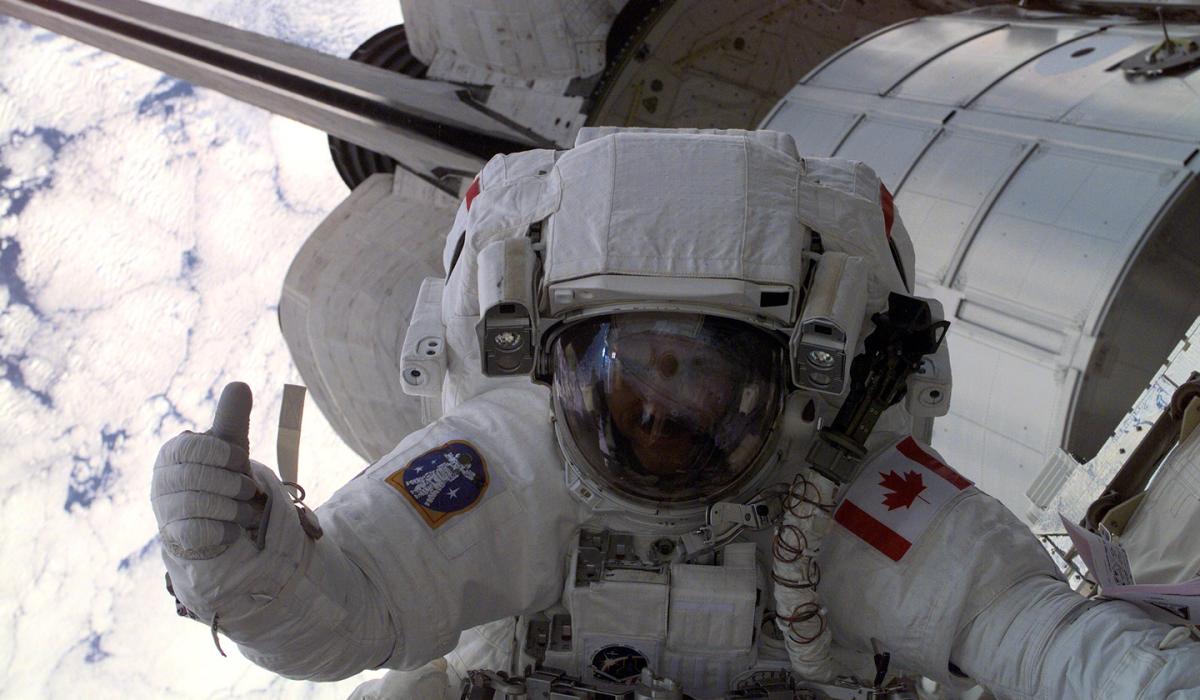
On April 22, 2001, Chris Hadfield became the first Canadian to perform a spacewalk when he and American Scott Parazynski left the Space Shuttle Endeavour to attach the Canadarm2 to the International Space Station. Twenty-five years later, Canada is part of another milestone in space: astronaut Jeremy Hansen’s historic trip around the moon with NASA’s Artemis II mission. Be Giant spoke to Hadfield, a former commander of the International Space Station and a best-selling author, about Canada’s first spacewalk, Hansen’s mission, how we should peacefully populate the moon and what Canadian “space sovereignty” really means.
Q: Commander Hadfield, take us back to that day 25 years ago.
A: My first spacewalk began in my mind when I was nine years old, because I was watching the very first human beings do spacewalks. And then, of course, [during] maybe the most historic spacewalk of all, when Neil Armstrong and Buzz Aldrin walked on the surface of the moon, I was about to turn 10. I thought, “That’s what I want to do.”
Imagine what it was like, April, 25 years ago, inside the airlock, wearing that spacesuit; opening up the hatch and pulling myself out into the universe with a Canadian flag on the shoulder of my suit. It was an amazing moment to have my childhood dreams coming true, but also the perspective that it brings you, to be on the outside of a ship orbiting the world.
Get our weekly newsletter – the people, places, and ideas revealing where Canada is headed.
Q: You experienced temporary blindness on that spacewalk. Tell me about that.
A: The spacesuit is a one-person spaceship. It’s completely self-contained. Inside the suit is a water bag [with] a tube and a bite valve. During my first spacewalk – during Canada’s first spacewalk – the bag was leaking and the bite valve and tube didn’t work. I couldn’t drink but, also, water was floating inside my helmet. One of those bubbles of water picked up contamination and got into my eye. [My eye] was blurry with tears and hurt like crazy. I thought, “It’ll clear and I’ll keep on.”
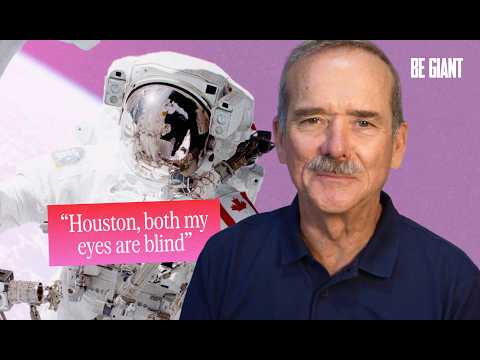
Without gravity, tears don’t fall, so that ball of tears wasn’t draining. It got bigger until it flowed across the bridge of my nose, into my other eye. Then both my eyes were blinded. I had to stop what I was doing [and] call down to Houston. I’d worked in mission control, so I knew this was going to be like rolling a grenade in there. Like, “Hey Houston, sorry, but there’s contamination in my suit. Both my eyes are blind. What do you want me to do?”
We decided the safest plan was to flush the contamination out of the suit with fresh oxygen. Over time, I could sort of see again. We ended up doing one of the longest spacewalks in history, over eight hours. [The contamination] turned out to be something so prosaic: the anti-fog [solution in the visor]. Now we use baby shampoo, which doesn’t make tears.
Q: We have another big milestone with Jeremy Hansen’s mission around the moon.
A: The only people who have left Earth orbit are 24 Americans, who did it during the Apollo program. Twelve walked on the surface of the moon. On Artemis II, there are four people on board that are going to risk their lives to take one of the next important steps in settling the moon. It’s three Americans and a Canadian: Jeremy Hansen from the tiny town of Ailsa Craig, Ont.; [he’s] a military CF-18 pilot, physicist, an all-around great guy.
It’s a wonderful measure of Canada, of the type of people we produce, but also our ability to constructively co-operate with other nations over decades. I am so delighted for Jeremy and his family. He has done the work. He’s earned this.
Q: Canada has a legacy in space with the Canadarm and contributions from astronauts like yourself and Jeremy Hansen. But there’s also been criticism that we haven’t invested enough in space. What do you think “space sovereignty” should mean for Canada?
A: I am immensely proud to be Canadian. How do we protect it? As the world becomes more technologically dependent, the way you defend sovereignty has to change. Above the atmosphere, space-based assets give insight into Canada, [like] what is going on in the Arctic? What is going on with the Northwest Passage? How are we able to protect ourselves?
We’ve realized that we’re more vulnerable than we should have been. We were counting on other nations and their goodwill for us to stay sovereign. That’s unsustainable. A lot of people are jealous of what Canada has. If we can’t defend it, someone will take it away.
Canada has recently made a long overdue move to be able to launch our own satellites. Developing our own ability to launch [and] build satellites, to maintain and operate them – that makes a lot of sense.
Q: NASA has announced plans to build a moon base in coming years. I’m curious to know your thoughts about establishing a human presence on the moon.
A: It’s inevitable. We are at the stage of human history where the technology is good enough not just to live on a space station, orbiting the world, but to start settling the moon. It’s a big landmass and it has no life. There is no biosphere to disrupt, like there might be on Mars.
We have the opportunity to start to develop an Earth-moon economic system. Like other historical first moves, it seems crazy. But the moon is there and it beckons.
As you mentioned, the recent announcements by NASA of how that’s going to happen – I mean, you’ve got to be flexible. You learn stuff; politics change; technology advances. Canada has been a strong partner internationally with the European Space Agency [and] with NASA. We’ll continue to be. We’re part of the Artemis Accords, 55-plus countries that are working together to figure out how we should peacefully settle the moon.
I helped found the Open Lunar Foundation. We look at [questions like], whose laws should apply? If we discover something of value, who does it belong to? If you commit a crime on the moon, what court do you appear in? We’re trying to be a good influence, now that it is historically and technologically the time when that’s going to happen.
Q: Can you talk about the role of collaboration in exploring space?
A: No single person can fly in space. You may be able to purchase the ability if you have enough money. But think about the infrastructure that has to exist for any one person to even go suborbital, let alone get into orbit or go all the way to the moon. Because of the technical complexity, it takes co-operation and co-ordination. Some tasks are so big that even one nation can’t sustainably take it on themselves; like the International Space Station – it was too much for any one nation. You need to spread the risk, cost, complexity and inventiveness over multiple countries, if you can.
That’s the case with the moon as well. Trying to do it individually may be possible as a one-shot demonstration deal, but it won’t be sustainable. It’s a good idea to get as many people as possible working towards the common goal of accomplishing something that humanity has never done before. The side benefit is, we share in the magnificence.
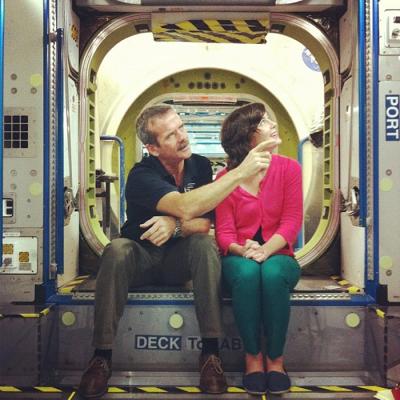
Q: You’ve written a number of books and spent much of your career giving your time to communicate about space. Tell me why you've made it a priority.
A: When I was a kid, [astronauts] were going to the moon with the Apollo program. I was mesmerized and inspired. They landed on the moon, and it was live — the most viewed event in human history. By the time I flew in space on my third flight, we had the internet and social media. I could take a picture and, within minutes, share it with a billion people. After I landed, I asked myself, “What am I going to do with this experience?” I want to contribute to the quality of life for as many people as possible, in a sustainable way.
It’s why I wrote my first book, An Astronaut's Guide to Life on Earth. Despite the immense imperfections in the world, there are still amazing, kind, progressive things happening. I want to be part of those. That’s why I write books, but it’s also why I do everything else.
My heart and wishes are with the Artemis II crew, wishing them technical success but also a complete and safe journey back to the surface of Earth with amazing stories to tell.
This interview has been edited for length and clarity.